- [The BasePlus package](#baseplus-package)
- [Content description](#content-description)
* [`%getVars()` macro](#getvars-macro)
* [`%QgetVars()` macro](#qgetvars-macro)
* [`%symdelGlobal()` macro](#symdelglobal-macro)
* [`bool.` format](#bool-format)
* [`boolz.` format](#boolz-format)
* [`ceil.` format](#ceil-format)
* [`floor.` format](#floor-format)
* [`int.` format](#int-format)
* [`arrFill()` subroutine](#arrfill-subroutine)
* [`arrFillC()` subroutine](#arrfillc-subroutine)
* [`arrMissFill()` subroutine](#arrmissfill-subroutine)
* [`arrMissFillC()` subroutine](#arrmissfillc-subroutine)
* [`arrMissToLeft()` subroutine](#arrmisstoleft-subroutine)
* [`arrMissToLeftC()` subroutine](#arrmisstoleftc-subroutine)
* [`arrMissToRight()` subroutine](#arrmisstoright-subroutine)
* [`arrMissToRightC()` subroutine](#arrmisstorightc-subroutine)
* [`catXFc()` function](#catxfc-function)
* [`catXFi()` function](#catxfi-function)
* [`catXFj()` function](#catxfj-function)
* [`catXFn()` function](#catxfn-function)
* [`delDataset()` function](#deldataset-function)
* [`qsortInCbyProcProto()` proto function](#qsortincbyprocproto-proto-function)
* [`fromMissingToNumberBS()` function](#frommissingtonumberbs-function)
* [`fromNumberToMissing()` function](#fromnumbertomissing-function)
* [`quickSort4NotMiss()` subroutine](#quicksort4notmiss-subroutine)
* [`quickSortHash()` subroutine](#quicksorthash-subroutine)
* [`quickSortHashSDDV()` subroutine](#quicksorthashsddv-subroutine)
* [`quickSortLight()` subroutine](#quicksortlight-subroutine)
* [`%dedupListS()` macro](#deduplists-macro)
* [`%dedupListC()` macro](#deduplistc-macro)
* [`%dedupListP()` macro](#deduplistp-macro)
* [`%dedupListX()` macro](#deduplistx-macro)
* [`%QdedupListX()` macro](#qdeduplistx-macro)
* [`brackets.` format](#brackets-format)
* [`semicolon.` format](#semicolon-format)
* [`bracketsC()` function](#bracketsc-function)
* [`bracketsN()` function](#bracketsn-function)
* [`semicolonC()` function](#semicolonc-function)
* [`semicolonN()` function](#semicolonn-function)
* [`%zipEvalf()` macro](#zipevalf-macro)
* [`%QzipEvalf()` macro](#qzipevalf-macro)
* [`%functionExists()` macro](#functionexists-macro)
* [`%RainCloudPlot()` macro](#raincloudplot-macro)
* [`%zipLibrary()` macro](#ziplibrary-macro)
* [`%unzipLibrary()` macro](#unziplibrary-macro)
* [`%LDSN()` macro](#ldsn-macro)
* [`%LDsNm()` macro](#ldsnm-macro)
* [`%LVarNm()` macro](#lvarnm-macro)
* [`%LVarNmLab()` macro](#lvarnmlab-macro)
* [`%bpPIPE()` macro](#bppipe-macro)
* [`%dirsAndFiles()` macro](#dirsandfiles-macro)
* [`%repeatTxt()` macro](#repeattxt-macro)
* [`%intsList()` macro](#intslist-macro)
* [`%letters()` macro](#letters-macro)
* [`%splitDSIntoBlocks()` macro](#splitdsintoblocks-macro)
* [`%splitDSIntoParts()` macro](#splitdsintoparts-macro)
* [`%filePath()` macro](#filepath-macro)
* [`%libPath()` macro](#libpath-macro)
* [`%workPath()` macro](#workpath-macro)
* [`%translate()` macro](#translate-macro)
* [`%tranwrd()` macro](#tranwrd-macro)
* [`%findDSwithVarVal()` macro](#finddswithvarval-macro)
* [`%getTitle()` macro](#gettitle-macro)
* [License](#license)
---
# The BasePlus package [ver. 1.26.1] ###############################################
The **BasePlus** package implements useful
functions and functionalities I miss in the BASE SAS.
It is inspired by various people, e.g.
- at the SAS-L discussion list
- at the communities.sas.com (SASware Ballot Ideas)
- at the Office...
- etc.
Kudos to all who inspired me to generate this package:
*Mark Keintz*,
*Paul Dorfman*,
*Richard DeVenezia*,
*Christian Graffeuille*,
*Allan Bowe*,
*Anamaria Calai*,
*Michal Ludwicki*,
*Quentin McMullen*,
*Kurt Bremser*.
Recording from the SAS Explore 2022 conference: [A BasePlus Package for SAS](https://communities.sas.com/t5/SAS-Explore-Presentations/A-BasePlus-Package-for-SAS/ta-p/838246 "A BasePlus Package for SAS") (September 27th-29th, 2022).
---
### BASIC EXAMPLES AND USECASES: ####################################################
**Example 1**: One-dimensional array functions.
Array parameters to subroutine
calls must be 1-based.
~~~~~~~~~~~~~~~~~~~~~~~~~~~~~~~~~~~~~~~~~~~~~~~~~~~~~~~~~~~~~~~~~~~~~~~~~~~~~~~~~~~~~sas
data _null_;
array X[4] _temporary_ (. 1 . 2);
call arrMissToRight(X);
do i = 1 to 4;
put X[i]= @;
end;
put;
call arrFillMiss(17, X);
do i = 1 to 4;
put X[i]= @;
end;
put;
call arrFill(42, X);
do i = 1 to 4;
put X[i]= @;
end;
run;
~~~~~~~~~~~~~~~~~~~~~~~~~~~~~~~~~~~~~~~~~~~~~~~~~~~~~~~~~~~~~~~~~~~~~~~~~~~~~~~~~~~~~
**Example 2**: Delete dataset by name.
~~~~~~~~~~~~~~~~~~~~~~~~~~~~~~~~~~~~~~~~~~~~~~~~~~~~~~~~~~~~~~~~~~~~~~~~~~~~~~~~~~~~~sas
data toDrop;
x = 17;
run;
data _null_;
p = delDataset("toDrop");
put p=;
run;
~~~~~~~~~~~~~~~~~~~~~~~~~~~~~~~~~~~~~~~~~~~~~~~~~~~~~~~~~~~~~~~~~~~~~~~~~~~~~~~~~~~~~
**Example 3**: Strings concatenation with format.
~~~~~~~~~~~~~~~~~~~~~~~~~~~~~~~~~~~~~~~~~~~~~~~~~~~~~~~~~~~~~~~~~~~~~~~~~~~~~~~~~~~~~sas
data test;
x = 1 ; y = . ; z = 3 ;
t = "t"; u = " "; v = "v";
array a[*] x y z;
array b[*] t u v;
length s1 s2 s3 s4 $ 17;
s1 = catXFn("z5.", "#", A);
s2 = catXFi("z5.", "#", A);
s3 = catXFc("upcase.", "*", B);
s4 = catXFj("upcase.", "*", B);
put (_all_) (=);
run;
~~~~~~~~~~~~~~~~~~~~~~~~~~~~~~~~~~~~~~~~~~~~~~~~~~~~~~~~~~~~~~~~~~~~~~~~~~~~~~~~~~~~~
**Example 4**: Useful formats.
~~~~~~~~~~~~~~~~~~~~~~~~~~~~~~~~~~~~~~~~~~~~~~~~~~~~~~~~~~~~~~~~~~~~~~~~~~~~~~~~~~~~~sas
data _null_;
input x @@;
put @1 x= @11 x= bool. @21 x= int. @31 x= ceil. @41 x= floor.;
cards;
. ._ .A -10 -3.14 0 3.14 10
;
run;
~~~~~~~~~~~~~~~~~~~~~~~~~~~~~~~~~~~~~~~~~~~~~~~~~~~~~~~~~~~~~~~~~~~~~~~~~~~~~~~~~~~~~
**Example 5**: Getting variables names from datasets.
~~~~~~~~~~~~~~~~~~~~~~~~~~~~~~~~~~~~~~~~~~~~~~~~~~~~~~~~~~~~~~~~~~~~~~~~~~~~~~~~~~~~~sas
%put *%getVars(sashelp.class
,pattern = ght$
,sep = +
,varRange = _numeric_)*;
~~~~~~~~~~~~~~~~~~~~~~~~~~~~~~~~~~~~~~~~~~~~~~~~~~~~~~~~~~~~~~~~~~~~~~~~~~~~~~~~~~~~~
**Example 6**: Quick sort as an alternative to call sortn()
~~~~~~~~~~~~~~~~~~~~~~~~~~~~~~~~~~~~~~~~~~~~~~~~~~~~~~~~~~~~~~~~~~~~~~~~~~~~~~~~~~~~~sas
data _null_;
array test[25000000] _temporary_ ;
t = time();
call streaminit(123);
do _N_ = 25000000 to 1 by -1;
test[_N_] = rand("uniform");
end;
t = time() - t;
put "Array population time: " t;
t = time();
call quickSortLight (test);
t = time()-t;
put "Sorting time: " / t=;
run;
~~~~~~~~~~~~~~~~~~~~~~~~~~~~~~~~~~~~~~~~~~~~~~~~~~~~~~~~~~~~~~~~~~~~~~~~~~~~~~~~~~~~~
**Example 7**: De-duplicate values from a space separated list.
~~~~~~~~~~~~~~~~~~~~~~~~~~~~~~~~~~~~~~~~~~~~~~~~~~~~~~~~~~~~~~~~~~~~~~~~~~~~~~~~~~~~~sas
%let list = 4 5 6 1 2 3 1 2 3 4 5 6;
%put *%dedupListS(&list.)*;
~~~~~~~~~~~~~~~~~~~~~~~~~~~~~~~~~~~~~~~~~~~~~~~~~~~~~~~~~~~~~~~~~~~~~~~~~~~~~~~~~~~~~
**Example 8**: Zip elements of two space separated list.
~~~~~~~~~~~~~~~~~~~~~~~~~~~~~~~~~~~~~~~~~~~~~~~~~~~~~~~~~~~~~~~~~~~~~~~~~~~~~~~~~~~~~sas
%let x = %zipEvalf(1 2 3 4 5 6, 2018 2019 2020, argMd=5, function=MDY, format=date11.);
%put &=x;
~~~~~~~~~~~~~~~~~~~~~~~~~~~~~~~~~~~~~~~~~~~~~~~~~~~~~~~~~~~~~~~~~~~~~~~~~~~~~~~~~~~~~
**Example 9**: Simple Rain Cloud plot.
~~~~~~~~~~~~~~~~~~~~~~~~~~~~~~~~~~~~~~~~~~~~~~~~~~~~~~~~~~~~~~~~~~~~~~~~~~~~~~~~~~~~~sas
%rainCloudPlot(sashelp.cars,DriveTrain,Invoice)
~~~~~~~~~~~~~~~~~~~~~~~~~~~~~~~~~~~~~~~~~~~~~~~~~~~~~~~~~~~~~~~~~~~~~~~~~~~~~~~~~~~~~
**Example 10**: Zip SAS library.
~~~~~~~~~~~~~~~~~~~~~~~~~~~~~~~~~~~~~~~~~~~~~~~~~~~~~~~~~~~~~~~~~~~~~~~~~~~~~~~~~~~~~sas
%zipLibrary(sashelp, libOut=work)
%unzipLibrary(%sysfunc(pathname(work)), zip=sashelp, mode=S, clean=1)
~~~~~~~~~~~~~~~~~~~~~~~~~~~~~~~~~~~~~~~~~~~~~~~~~~~~~~~~~~~~~~~~~~~~~~~~~~~~~~~~~~~~~
**Example 11**: Long dataset names.
~~~~~~~~~~~~~~~~~~~~~~~~~~~~~~~~~~~~~~~~~~~~~~~~~~~~~~~~~~~~~~~~~~~~~~~~~~~~~~~~~~~~~sas
data %LDSN( work. peanut butter & jelly with a "Hot-Dog" in [a box], popcorn, and s*t*a*r*s (drop = sex rename=(name=first_name) where = (age in (12,13,14))) );
set sashelp.class;
run;
proc print data = %LDSN( work. peanut butter & jelly with a "Hot-Dog" in [a box], popcorn, and s*t*a*r*s );
run;
data MyNextDataset;
set %LDSN( work. peanut butter & jelly with a "Hot-Dog" in [a box], popcorn, and s*t*a*r*s );
where age > 12;
run;
~~~~~~~~~~~~~~~~~~~~~~~~~~~~~~~~~~~~~~~~~~~~~~~~~~~~~~~~~~~~~~~~~~~~~~~~~~~~~~~~~~~~~
**Example 12**: List, to the log, content of `home` directory.
~~~~~~~~~~~~~~~~~~~~~~~~~~~~~~~~~~~~~~~~~~~~~~~~~~~~~~~~~~~~~~~~~~~~~~~~~~~~~~~~~~~~~sas
%bpPIPE(ls -la ~/)
~~~~~~~~~~~~~~~~~~~~~~~~~~~~~~~~~~~~~~~~~~~~~~~~~~~~~~~~~~~~~~~~~~~~~~~~~~~~~~~~~~~~~
**EXAMPLE 13** Get list of all files and directories from `C:\SAS_WORK\`:
~~~~~~~~~~~~~~~~~~~~~~~~~~~~~~~~~~~~~~~~~~~~~~~~~~~~~~~~~~~~~~~~~~~~~~~~~~~~~~~~~~~~~sas
%dirsAndFiles(C:\SAS_WORK\,ODS=work.result)
~~~~~~~~~~~~~~~~~~~~~~~~~~~~~~~~~~~~~~~~~~~~~~~~~~~~~~~~~~~~~~~~~~~~~~~~~~~~~~~~~~~~~
**EXAMPLE 14** Text repetition:
~~~~~~~~~~~~~~~~~~~~~~~~~~~~~~~~~~~~~~~~~~~~~~~~~~~~~~~~~~~~~~~~~~~~~~~~~~~~~~~~~~~~~sas
%put %repeatTxt(#,15,s=$) HELLO SAS! %repeatTxt(#,15,s=$);
~~~~~~~~~~~~~~~~~~~~~~~~~~~~~~~~~~~~~~~~~~~~~~~~~~~~~~~~~~~~~~~~~~~~~~~~~~~~~~~~~~~~~
**EXAMPLE 15** Integer list:
~~~~~~~~~~~~~~~~~~~~~~~~~~~~~~~~~~~~~~~~~~~~~~~~~~~~~~~~~~~~~~~~~~~~~~~~~~~~~~~~~~~~~sas
%put %intsList(42);
~~~~~~~~~~~~~~~~~~~~~~~~~~~~~~~~~~~~~~~~~~~~~~~~~~~~~~~~~~~~~~~~~~~~~~~~~~~~~~~~~~~~~
**EXAMPLE 16** Split dataset into blocks of 5 observations:
~~~~~~~~~~~~~~~~~~~~~~~~~~~~~~~~~~~~~~~~~~~~~~~~~~~~~~~~~~~~~~~~~~~~~~~~~~~~~~~~~~~~~sas
%splitDSIntoBlocks(5, sashelp.class, classBlock)
~~~~~~~~~~~~~~~~~~~~~~~~~~~~~~~~~~~~~~~~~~~~~~~~~~~~~~~~~~~~~~~~~~~~~~~~~~~~~~~~~~~~~
**EXAMPLE 17** Split dataset into 7 parts:
~~~~~~~~~~~~~~~~~~~~~~~~~~~~~~~~~~~~~~~~~~~~~~~~~~~~~~~~~~~~~~~~~~~~~~~~~~~~~~~~~~~~~sas
%splitDSIntoParts(7, sashelp.cars, carsPart)
~~~~~~~~~~~~~~~~~~~~~~~~~~~~~~~~~~~~~~~~~~~~~~~~~~~~~~~~~~~~~~~~~~~~~~~~~~~~~~~~~~~~~
**EXAMPLE 18** Return path to temporary file:
~~~~~~~~~~~~~~~~~~~~~~~~~~~~~~~~~~~~~~~~~~~~~~~~~~~~~~~~~~~~~~~~~~~~~~~~~~~~~~~~~~~~~sas
filename f temp;
%put %filePath(f);
~~~~~~~~~~~~~~~~~~~~~~~~~~~~~~~~~~~~~~~~~~~~~~~~~~~~~~~~~~~~~~~~~~~~~~~~~~~~~~~~~~~~~
**EXAMPLE 19** Get titles:
~~~~~~~~~~~~~~~~~~~~~~~~~~~~~~~~~~~~~~~~~~~~~~~~~~~~~~~~~~~~~~~~~~~~~~~~~~~~~~~~~~~~~sas
title1 j=c "Hi Roger" ;
title2 j=l "Good Morning" ;
title3 "How are you?" ;
title4 ;
title5 "Bye bye!" ;
%put %GetTitle(1 2 3 5, dlm=s, qt='') ;
~~~~~~~~~~~~~~~~~~~~~~~~~~~~~~~~~~~~~~~~~~~~~~~~~~~~~~~~~~~~~~~~~~~~~~~~~~~~~~~~~~~~~
---
Package contains:
1. macro bppipe
2. macro deduplistc
3. macro deduplistp
4. macro deduplists
5. macro deduplistx
6. macro dirsandfiles
7. macro functionexists
8. macro getvars
9. macro intslist
10. macro ldsn
11. macro ldsnm
12. macro lvarnm
13. macro lvarnmlab
14. macro qdeduplistx
15. macro qgetvars
16. macro qzipevalf
17. macro raincloudplot
18. macro repeattxt
19. macro splitdsintoblocks
20. macro splitdsintoparts
21. macro symdelglobal
22. macro unziplibrary
23. macro zipevalf
24. macro ziplibrary
25. format bool
26. format boolz
27. format ceil
28. format floor
29. format int
30. functions arrfill
31. functions arrfillc
32. functions arrmissfill
33. functions arrmissfillc
34. functions arrmisstoleft
35. functions arrmisstoleftc
36. functions arrmisstoright
37. functions arrmisstorightc
38. functions bracketsc
39. functions bracketsn
40. functions catxfc
41. functions catxfi
42. functions catxfj
43. functions catxfn
44. functions deldataset
45. functions semicolonc
46. functions semicolonn
47. format brackets
48. format semicolon
49. proto qsortincbyprocproto
50. functions frommissingtonumberbs
51. functions fromnumbertomissing
52. functions quicksort4notmiss
53. functions quicksorthash
54. functions quicksorthashsddv
55. functions quicksortlight
56. macro filepath
57. macro finddswithvarval
58. macro gettitle
59. macro letters
60. macro libpath
61. macro translate
62. macro tranwrd
63. macro workpath
Package contains additional content, run: %loadPackageAddCnt(BasePlus) to load it
or look for the baseplus_AdditionalContent directory in the Packages fileref
localization (only if additional content was deployed during the installation process).
* SAS package generated by generatePackage, version 20230520 *
The SHA256 hash digest for package BasePlus:
`F*D6DC5AD1B60A92AD300B639B3C361C1F7846EB01E5AB35BF4FDDA6E783408172`
---
# Content description ############################################################################################
## >>> `%getVars()` macro: <<< #######################
The getVars() and QgetVars() macro functions
allow to extract variables names form a dataset
according to a given pattern into a list.
The getVars() returns unquoted value [by %unquote()].
The QgetVars() returns quoted value [by %superq()].
See examples below for the details.
The `%getVars()` macro executes like a pure macro code.
### SYNTAX: ###################################################################
The basic syntax is the following, the `<...>` means optional parameters:
~~~~~~~~~~~~~~~~~~~~~~~sas
%getVars(
ds
<,sep=>
<,pattern=>
<,varRange=>
<,quote=>
<,mcArray=>
)
~~~~~~~~~~~~~~~~~~~~~~~
**Arguments description**:
1. `ds` - *Required*, the name of the dataset from
which variables are to be taken.
* `sep = %str( )` - *Optional*, default value `%str( )`,
a variables separator on the created list.
* `pattern = .*` - *Optional*, default value `.*` (i.e. any text),
a variable name regexp pattern, case INSENSITIVE!
* `varRange = _all_` - *Optional*, default value `_all_`,
a named range list of variables.
* `quote =` - *Optional*, default value is blank, a quotation
symbol to be used around values.
* `mcArray=` - *Optional*, default value is blank.
1) When *null* - the macro behaves like a macro function
and returns a text string with variables list.
2) When *not null* - behaviour of the macro is altered.
In such case a macro array of selected variables, named
with `mcArray` value as a prefix, is created.
Furthermore a macro named as `mcArray` value is generated.
(see the macroArray package for the details).
When `mcArray=` parameter is active the `getVars` macro
cannot be called within the `%put` statement. Execution like:
`%put %getVars(..., mcArray=XXX);` will result with
an Explicit & Radical Refuse Of Run (aka ERROR).
### EXAMPLES AND USECASES: ####################################################
**EXAMPLE 1.** A list of all variables from the
sashelp.class dataset:
~~~~~~~~~~~~~~~~~~~~~~~~~~~~~~~~~~~~~~~~~~~~~~~~~~~~~~~~~~~~~~~~sas
%put *%getVars(sashelp.class)*;
~~~~~~~~~~~~~~~~~~~~~~~~~~~~~~~~~~~~~~~~~~~~~~~~~~~~~~~~~~~~~~~~
**EXAMPLE 2.** A list of all variables from the
sashelp.class dataset separated
by backslash:
~~~~~~~~~~~~~~~~~~~~~~~~~~~~~~~~~~~~~~~~~~~~~~~~~~~~~~~~~~~~~~~~sas
%let x = %getVars(sashelp.class, sep=\);
%put &=x;
~~~~~~~~~~~~~~~~~~~~~~~~~~~~~~~~~~~~~~~~~~~~~~~~~~~~~~~~~~~~~~~~
**EXAMPLE 3.** Use of regular expressions:
a) A list of variables which name contains "i" or "a"
~~~~~~~~~~~~~~~~~~~~~~~~~~~~~~~~~~~~~~~~~~~~~~~~~~~~~~~~~~~~~~~~sas
%put *%getVars(sashelp.class, pattern=i|a)*;
~~~~~~~~~~~~~~~~~~~~~~~~~~~~~~~~~~~~~~~~~~~~~~~~~~~~~~~~~~~~~~~~
b) A list of variables which name starts with "w"
~~~~~~~~~~~~~~~~~~~~~~~~~~~~~~~~~~~~~~~~~~~~~~~~~~~~~~~~~~~~~~~~sas
%put *%getVars(sashelp.class, pattern=^w)*;
~~~~~~~~~~~~~~~~~~~~~~~~~~~~~~~~~~~~~~~~~~~~~~~~~~~~~~~~~~~~~~~~
c) A list of variables which name ends with "ght"
~~~~~~~~~~~~~~~~~~~~~~~~~~~~~~~~~~~~~~~~~~~~~~~~~~~~~~~~~~~~~~~~sas
%put *%getVars(sashelp.class, pattern=ght$)*;
~~~~~~~~~~~~~~~~~~~~~~~~~~~~~~~~~~~~~~~~~~~~~~~~~~~~~~~~~~~~~~~~
**EXAMPLE 4.** A list of numeric variables which name
starts with "w" or "h" or ends with "x"
~~~~~~~~~~~~~~~~~~~~~~~~~~~~~~~~~~~~~~~~~~~~~~~~~~~~~~~~~~~~~~~~~~~~~~~~~~~~~~~~~~~~~sas
%put *%getVars(sashelp.class, sep=+, pattern=^(w|h)|x$, varRange=_numeric_)*;
~~~~~~~~~~~~~~~~~~~~~~~~~~~~~~~~~~~~~~~~~~~~~~~~~~~~~~~~~~~~~~~~~~~~~~~~~~~~~~~~~~~~~
**EXAMPLE 5.**
~~~~~~~~~~~~~~~~~~~~~~~~~~~~~~~~~~~~~~~~~~~~~~~~~~~~~~~~~~~~~~~~~~~~~~~~~~~~~~~~~~~~~sas
data test;
array x[30];
array y[30] $ ;
array z[30];
run;
~~~~~~~~~~~~~~~~~~~~~~~~~~~~~~~~~~~~~~~~~~~~~~~~~~~~~~~~~~~~~~~~~~~~~~~~~~~~~~~~~~~~~
a) A list of variables separated by a comma:
~~~~~~~~~~~~~~~~~~~~~~~~~~~~~~~~~~~~~~~~~~~~~~~~~~~~~~~~~~~~~~~~~~~~~~~~~~~~~~~~~~~~~sas
%put *%getVars(test, sep=%str(,))*;
~~~~~~~~~~~~~~~~~~~~~~~~~~~~~~~~~~~~~~~~~~~~~~~~~~~~~~~~~~~~~~~~~~~~~~~~~~~~~~~~~~~~~
b) A list of variables separated by a comma
with suffix 5 or 7:
~~~~~~~~~~~~~~~~~~~~~~~~~~~~~~~~~~~~~~~~~~~~~~~~~~~~~~~~~~~~~~~~~~~~~~~~~~~~~~~~~~~~~sas
%put *%getVars(test, sep=%str(,), pattern=(5|7)$)*;
~~~~~~~~~~~~~~~~~~~~~~~~~~~~~~~~~~~~~~~~~~~~~~~~~~~~~~~~~~~~~~~~~~~~~~~~~~~~~~~~~~~~~
c) A list of variables separated by a comma
with suffix 5 or 7 from a given variables range:
~~~~~~~~~~~~~~~~~~~~~~~~~~~~~~~~~~~~~~~~~~~~~~~~~~~~~~~~~~~~~~~~~~~~~~~~~~~~~~~~~~~~~sas
%put *%getVars(test, sep=%str(,), varRange=x10-numeric-z22 y6-y26, pattern=(5|7)$)*;
~~~~~~~~~~~~~~~~~~~~~~~~~~~~~~~~~~~~~~~~~~~~~~~~~~~~~~~~~~~~~~~~~~~~~~~~~~~~~~~~~~~~~
**EXAMPLE 6.** Case of quotes and special characters
when the quote= parameter is _not_ used:
a) one single or double qiote:
~~~~~~~~~~~~~~~~~~~~~~~~~~~~~~~~~~~~~~~~~~~~~~~~~~~~~~~~~~~~~~~~~~~~~~~~~~~~~~~~~~~~~sas
%put *%bquote(%getVars(sashelp.class, sep=%str(%")))*;
%put *%bquote(%getVars(sashelp.class, sep=%str(%')))*;
~~~~~~~~~~~~~~~~~~~~~~~~~~~~~~~~~~~~~~~~~~~~~~~~~~~~~~~~~~~~~~~~~~~~~~~~~~~~~~~~~~~~~
b) two single or double qiotes:
~~~~~~~~~~~~~~~~~~~~~~~~~~~~~~~~~~~~~~~~~~~~~~~~~~~~~~~~~~~~~~~~~~~~~~~~~~~~~~~~~~~~~sas
%put *"%bquote(%getVars(sashelp.class,sep=""))"*;
%put *%str(%')%bquote(%getVars(sashelp.class,sep=''))%str(%')*;
~~~~~~~~~~~~~~~~~~~~~~~~~~~~~~~~~~~~~~~~~~~~~~~~~~~~~~~~~~~~~~~~~~~~~~~~~~~~~~~~~~~~~
c) coma separated double quote list:
~~~~~~~~~~~~~~~~~~~~~~~~~~~~~~~~~~~~~~~~~~~~~~~~~~~~~~~~~~~~~~~~~~~~~~~~~~~~~~~~~~~~~sas
%put *"%getVars(sashelp.class,sep=%str(", "))"*;
~~~~~~~~~~~~~~~~~~~~~~~~~~~~~~~~~~~~~~~~~~~~~~~~~~~~~~~~~~~~~~~~~~~~~~~~~~~~~~~~~~~~~
d) coma separated single quote list:
~~~~~~~~~~~~~~~~~~~~~~~~~~~~~~~~~~~~~~~~~~~~~~~~~~~~~~~~~~~~~~~~~~~~~~~~~~~~~~~~~~~~~sas
%put *%str(%')%getVars(sashelp.class,sep=', ')%str(%')*;
%let x = %str(%')%getVars(sashelp.class,sep=', ')%str(%');
%put *%str(%')%QgetVars(sashelp.class,sep=', ')%str(%')*;
%let y = %str(%')%QgetVars(sashelp.class,sep=', ')%str(%');
%let z = %unquote(&y.);
~~~~~~~~~~~~~~~~~~~~~~~~~~~~~~~~~~~~~~~~~~~~~~~~~~~~~~~~~~~~~~~~~~~~~~~~~~~~~~~~~~~~~
e) ampersand (&) as a separator [compare behaviour]:
~~~~~~~~~~~~~~~~~~~~~~~~~~~~~~~~~~~~~~~~~~~~~~~~~~~~~~~~~~~~~~~~~~~~~~~~~~~~~~~~~~~~~sas
%put *%getVars(sashelp.class,sep=&)*;
%let x = %getVars(sashelp.class,sep=&);
%put *%getVars(sashelp.class,sep=%str( & ))*;
%let x = %getVars(sashelp.class,sep=%str( & ));
%put *%QgetVars(sashelp.class,sep=&)*;
%let y = %QgetVars(sashelp.class,sep=&);
%let z = %unquote(&y.);
%put *%QgetVars(sashelp.class,sep=%str( & ))*;
%let y = %QgetVars(sashelp.class,sep=%str( & ));
%let z = %unquote(&y.);
%put *%getVars(sashelp.class,sep=&)*;
%let x = %getVars(sashelp.class,sep=&);
%put *%getVars(sashelp.class,sep=%str( & ))*;
%let x = %getVars(sashelp.class,sep=%str( & ));
~~~~~~~~~~~~~~~~~~~~~~~~~~~~~~~~~~~~~~~~~~~~~~~~~~~~~~~~~~~~~~~~~~~~~~~~~~~~~~~~~~~~~
f) percent (%) as a separator [compare behaviour]:
~~~~~~~~~~~~~~~~~~~~~~~~~~~~~~~~~~~~~~~~~~~~~~~~~~~~~~~~~~~~~~~~~~~~~~~~~~~~~~~~~~~~~sas
%put *%QgetVars(sashelp.class,sep=%)*;
%let y = %QgetVars(sashelp.class,sep=%);
%let z = %unquote(&y.);
%put *%QgetVars(sashelp.class,sep=%str( % ))*;
%let y = %QgetVars(sashelp.class,sep=%str( % ));
%let z = %unquote(&y.);
~~~~~~~~~~~~~~~~~~~~~~~~~~~~~~~~~~~~~~~~~~~~~~~~~~~~~~~~~~~~~~~~~~~~~~~~~~~~~~~~~~~~~
**EXAMPLE 7.** Case of quotes and special characters
when the quote= parameter is used:
a) one single or double qiote:
~~~~~~~~~~~~~~~~~~~~~~~~~~~~~~~~~~~~~~~~~~~~~~~~~~~~~~~~~~~~~~~~~~~~~~~~~~~~~~~~~~~~~sas
%put *%getVars(sashelp.class, quote=%str(%"))*;
%put *%getVars(sashelp.class, quote=%str(%'))*;
~~~~~~~~~~~~~~~~~~~~~~~~~~~~~~~~~~~~~~~~~~~~~~~~~~~~~~~~~~~~~~~~~~~~~~~~~~~~~~~~~~~~~
b) two single or double quotes:
~~~~~~~~~~~~~~~~~~~~~~~~~~~~~~~~~~~~~~~~~~~~~~~~~~~~~~~~~~~~~~~~~~~~~~~~~~~~~~~~~~~~~sas
%* this gives an error: ;
%* %put *%getVars(sashelp.class,quote="")*;
%* %put *%getVars(sashelp.class,quote='')*;
%* this does not give an error: ;
%put *%QgetVars(sashelp.class,quote="")*;
%put *%QgetVars(sashelp.class,quote='')*;
~~~~~~~~~~~~~~~~~~~~~~~~~~~~~~~~~~~~~~~~~~~~~~~~~~~~~~~~~~~~~~~~~~~~~~~~~~~~~~~~~~~~~
c) coma separated double quote list:
~~~~~~~~~~~~~~~~~~~~~~~~~~~~~~~~~~~~~~~~~~~~~~~~~~~~~~~~~~~~~~~~~~~~~~~~~~~~~~~~~~~~~sas
%put *%getVars(sashelp.class,sep=%str(,),quote=%str(%"))*;
~~~~~~~~~~~~~~~~~~~~~~~~~~~~~~~~~~~~~~~~~~~~~~~~~~~~~~~~~~~~~~~~~~~~~~~~~~~~~~~~~~~~~
d) coma separated single quote list:
~~~~~~~~~~~~~~~~~~~~~~~~~~~~~~~~~~~~~~~~~~~~~~~~~~~~~~~~~~~~~~~~~~~~~~~~~~~~~~~~~~~~~sas
%let x = %getVars(sashelp.class,sep=%str(,),quote=%str(%'));
%put &=x.;
~~~~~~~~~~~~~~~~~~~~~~~~~~~~~~~~~~~~~~~~~~~~~~~~~~~~~~~~~~~~~~~~~~~~~~~~~~~~~~~~~~~~~
**EXAMPLE 8.** Variables that start with `A` and do not end with `GHT`:
~~~~~~~~~~~~~~~~~~~~~~~~~~~~~~~~~~~~~~~~~~~~~~~~~~~~~~~~~~~~~~~~~~~~~~~~~~~~~~~~~~~~~sas
data class;
set sashelp.class;
Aeight = height;
run;
%put *%getVars(class, pattern = ^A(.*)(?>> `%QgetVars()` macro: <<< #######################
The getVars() and QgetVars() macro functions
allow to extract variables names form a dataset
according to a given pattern into a list.
The getVars() returns unquoted value [by %unquote()].
The QgetVars() returns quoted value [by %superq()].
The `%QgetVars()` macro executes like a pure macro code.
### SYNTAX: ###################################################################
The basic syntax is the following, the `<...>` means optional parameters:
~~~~~~~~~~~~~~~~~~~~~~~sas
%QgetVars(
ds
<,sep=>
<,pattern=>
<,varRange=>
<,quote=>
)
~~~~~~~~~~~~~~~~~~~~~~~
**Arguments description**:
1. `ds` - *Required*, the name of the dataset from
which variables are to be taken.
* `sep = %str( )` - *Optional*, default value `%str( )`,
a variables separator on the created list.
* `pattern = .*` - *Optional*, default value `.*` (i.e. any text),
a variable name regexp pattern, case INSENSITIVE!
* `varRange = _all_` - *Optional*, default value `_all_`,
a named range list of variables.
* `quote =` - *Optional*, default value is blank, a quotation
symbol to be used around values.
### EXAMPLES AND USECASES: ####################################################
See examples in `%getVars()` help for the details.
---
## >>> `%symdelGlobal()` macro: <<< #######################
The `%symdelGlobal()` macro deletes all global macrovariables
created by the user. The only exceptions are read only variables
and variables the one which starts with SYS, AF, or FSP.
In that case a warning is printed in the log.
One temporary global macrovariable `________________98_76_54_32_10_`
and a dataset, in `work` library, named `_%sysfunc(datetime(),hex7.)`
are created and deleted during the process.
The `%symdelGlobal()` macro executes like a pure macro code.
### SYNTAX: ###################################################################
The basic syntax is the following, the `<...>` means optional parameters:
~~~~~~~~~~~~~~~~~~~~~~~sas
%symdelGlobal(
info
)
~~~~~~~~~~~~~~~~~~~~~~~
**Arguments description**:
1. `info` - *Optional*, default value should be empty,
if set to `NOINFO` or `QUIET` then infos and
warnings about variables deletion are suspended.
### EXAMPLES AND USECASES: ####################################################
**EXAMPLE 1.** Basic use-case one.
Delete global macrovariables, info notes
and warnings are printed in the log.
~~~~~~~~~~~~~~~~~~~~~~~~~~~~~~~~~~~~~~~~~~~~~~~~~~~~~~~~~~~~~~~~sas
%let a = 1;
%let b = 2;
%let c = 3;
%let sys_my_var = 11;
%let af_my_var = 22;
%let fsp_my_var = 33;
%global / readonly read_only_x = 1234567890;
%put _user_;
%symdelGlobal();
%put _user_;
~~~~~~~~~~~~~~~~~~~~~~~~~~~~~~~~~~~~~~~~~~~~~~~~~~~~~~~~~~~~~~~~
**EXAMPLE 2.** Basic use-case two.
Delete global macrovariables in quite mode
No info notes and warnings are printed in the log.
~~~~~~~~~~~~~~~~~~~~~~~~~~~~~~~~~~~~~~~~~~~~~~~~~~~~~~~~~~~~~~~~sas
%let a = 1;
%let b = 2;
%let c = 3;
%let sys_my_var = 11;
%let af_my_var = 22;
%let fsp_my_var = 33;
%global / readonly read_only_x = 1234567890;
%put _user_;
%put *%symdelGlobal(NOINFO)*;
%put _user_;
~~~~~~~~~~~~~~~~~~~~~~~~~~~~~~~~~~~~~~~~~~~~~~~~~~~~~~~~~~~~~~~~
---
## >>> `bool.` format: <<< #######################
The **bool** format returns:
*zero* for 0 or missing,
*one* for other values.
### EXAMPLES AND USECASES: ####################################################
It allows for a %sysevalf()'ish
conversion-type [i.e. `%sysevalf(1.7 & 4.2, boolean)`]
inside the `%sysfunc()` [e.g. `%sysfunc(aFunction(), bool.)`]
---
## >>> `boolz.` format: <<< #######################
The **boolz** format returns:
*zero* for 0 or missing,
*one* for other values.
*Fuzz* value is 0.
### EXAMPLES AND USECASES: ####################################################
It allows for a %sysevalf()'ish
conversion-type [i.e. `%sysevalf(1.7 & 4.2, boolean)`]
inside the `%sysfunc()` [e.g. `%sysfunc(aFunction(), boolz.)`]
---
## >>> `ceil.` format: <<< #######################
The **ceil** format is a "wrapper" for the `ceil()` function.
### EXAMPLES AND USECASES: ####################################################
It allows for a %sysevalf()'ish
conversion-type [i.e. `%sysevalf(1.7 + 4.2, ceil)`]
inside the `%sysfunc()` [e.g. `%sysfunc(aFunction(), ceil.)`]
---
## >>> `floor.` format: <<< #######################
The **floor** format is a "wrapper" for the `floor()` function.
### EXAMPLES AND USECASES: ####################################################
It allows for a %sysevalf()'ish
conversion-type [i.e. `%sysevalf(1.7 + 4.2, floor)`]
inside the `%sysfunc()` [e.g. `%sysfunc(aFunction(), floor.)`]
---
## >>> `int.` format: <<< #######################
The **int** format is a "wrapper" for the `int()` function.
### EXAMPLES AND USECASES: ####################################################
It allows for a %sysevalf()'ish
conversion-type [i.e. `%sysevalf(1.7 + 4.2, integer)`]
inside the `%sysfunc()` [e.g. `%sysfunc(aFunction(), int.)`]
---
## >>> `arrFill()` subroutine: <<< #######################
The **arrFill()** subroutine is a wrapper
for the Call Fillmatrix() [a special FCMP subroutine].
A numeric array is filled with selected numeric value, e.g.
for array `A = [. . . .]` the subroutine
`call arrFill(42, A)` returns `A = [42 42 42 42]`
*Caution!* Array parameters to subroutine calls *must* be 1-based.
### SYNTAX: ###################################################################
The basic syntax is the following, the `<...>` means optional parameters:
~~~~~~~~~~~~~~~~~~~~~~~sas
call arrFill(N ,A)
~~~~~~~~~~~~~~~~~~~~~~~
**Arguments description**:
1. `N` - Numeric value.
2. `A` - Numeric array.
### EXAMPLES AND USECASES: ####################################################
**Example 1.**
~~~~~~~~~~~~~~~~~~~~~~~~~~~~~~~~~~~~~~~~~~~~~~~~~~~~~~~~~~~~~~~~sas
data _null_;
array X[*] a b c;
put "before: " (_all_) (=);
call arrFill(42, X);
put "after: " (_all_) (=);
run;
~~~~~~~~~~~~~~~~~~~~~~~~~~~~~~~~~~~~~~~~~~~~~~~~~~~~~~~~~~~~~~~~
---
## >>> `arrFillC()` subroutine: <<< #######################
The **arrFillC()** subroutine fills
a character array with selected character value, e.g.
for array `A = [" ", " ", " "]` the subroutine
`call arrFillC("B", A)` returns `A = ["B", "B", "B"]`
*Caution!* Array parameters to subroutine calls *must* be 1-based.
### SYNTAX: ###################################################################
The basic syntax is the following, the `<...>` means optional parameters:
~~~~~~~~~~~~~~~~~~~~~~~sas
call arrFillC(C ,A)
~~~~~~~~~~~~~~~~~~~~~~~
**Arguments description**:
1. `C` - Character value.
2. `A` - Character array.
### EXAMPLES AND USECASES: ####################################################
**Example 1.**
~~~~~~~~~~~~~~~~~~~~~~~~~~~~~~~~~~~~~~~~~~~~~~~~~~~~~~~~~~~~~~~~sas
data _null_;
array X[*] $ a b c;
put "before: " (_all_) (=);
call arrFillC("ABC", X);
put "after: " (_all_) (=);
run;
~~~~~~~~~~~~~~~~~~~~~~~~~~~~~~~~~~~~~~~~~~~~~~~~~~~~~~~~~~~~~~~~
---
## >>> `arrMissFill()` subroutine: <<< #######################
The **arrMissFill()** subroutine fills
all missing values (i.e. less or equal than `.Z`)
of a numeric array with selected numeric value, e.g.
for array `A = [1 . . 4]` the subroutine
`call arrMissFill(42, A)` returns `A = [1 42 42 4]`
*Caution!* Array parameters to subroutine calls *must* be 1-based.
### SYNTAX: ###################################################################
The basic syntax is the following, the `<...>` means optional parameters:
~~~~~~~~~~~~~~~~~~~~~~~sas
call arrMissFill(N ,A)
~~~~~~~~~~~~~~~~~~~~~~~
**Arguments description**:
1. `N` - Numeric value.
2. `A` - Numeric array.
### EXAMPLES AND USECASES: ####################################################
**Example 1.**
~~~~~~~~~~~~~~~~~~~~~~~~~~~~~~~~~~~~~~~~~~~~~~~~~~~~~~~~~~~~~~~~sas
data have;
input a b c;
cards4;
1 . 3
. 2 .
. . 3
;;;;
run;
data _null_;
set have ;
array X[*] a b c;
put "before: " (_all_) (=);
call arrMissFill(42, X);
put "after: " (_all_) (=);
run;
~~~~~~~~~~~~~~~~~~~~~~~~~~~~~~~~~~~~~~~~~~~~~~~~~~~~~~~~~~~~~~~~
---
## >>> `arrMissFillC()` subroutine: <<< #######################
The **arrMissFillC()** subroutine fills
all missing values of a character array
with selected character value, e.g.
for array `A = ["A", " ", "C"]` the subroutine
`call arrMissFillC("B", A)` returns `A = ["A", "B", "C"]`
*Caution!* Array parameters to subroutine calls *must* be 1-based.
### SYNTAX: ###################################################################
The basic syntax is the following, the `<...>` means optional parameters:
~~~~~~~~~~~~~~~~~~~~~~~sas
call arrMissFillC(C, A)
~~~~~~~~~~~~~~~~~~~~~~~
**Arguments description**:
1. `C` - Character value.
2. `A` - Character array.
### EXAMPLES AND USECASES: ####################################################
**Example 1.**
~~~~~~~~~~~~~~~~~~~~~~~~~~~~~~~~~~~~~~~~~~~~~~~~~~~~~~~~~~~~~~~~sas
data have;
infile cards dsd dlm="," missover;
input (a b c) (: $ 1.);
cards4;
A, ,C
,B,
, ,C
;;;;
run;
data _null_;
set have ;
array X[*] $ a b c;
put "before: " (_all_) (=);
call arrMissFillC("X", X);
put "after: " (_all_) (=);
run;
~~~~~~~~~~~~~~~~~~~~~~~~~~~~~~~~~~~~~~~~~~~~~~~~~~~~~~~~~~~~~~~~
---
## >>> `arrMissToLeft()` subroutine: <<< #######################
The **arrMissToLeft()** subroutine shifts
all non-missing (i.e. greater than `.Z`)
numeric elements to the right side of an array
and missing values to the left, e.g.
for array `A = [1 . 2 . 3]` the subroutine
`call arrMissToLeft(A)` returns `A = [. . 1 2 3]`
All missing values are replaced with the dot (`.`)
*Caution!* Array parameters to subroutine calls *must* be 1-based.
### SYNTAX: ###################################################################
The basic syntax is the following, the `<...>` means optional parameters:
~~~~~~~~~~~~~~~~~~~~~~~sas
call arrMissToLeft(A)
~~~~~~~~~~~~~~~~~~~~~~~
**Arguments description**:
1. `A` - Numeric array.
### EXAMPLES AND USECASES: ####################################################
**Example 1.**
~~~~~~~~~~~~~~~~~~~~~~~~~~~~~~~~~~~~~~~~~~~~~~~~~~~~~~~~~~~~~~~~sas
data have;
input a b c;
cards4;
1 . 3
. 2 .
. . 3
;;;;
run;
data _null_;
set have ;
array X[*] a b c;
put "before: " (_all_) (=);
call arrMissToLeft(X);
put "after: " (_all_) (=);
run;
~~~~~~~~~~~~~~~~~~~~~~~~~~~~~~~~~~~~~~~~~~~~~~~~~~~~~~~~~~~~~~~~
---
## >>> `arrMissToLeftC()` subroutine: <<< #######################
The **arrMissToLeftC()** subroutine shifts
all non-missing (i.e. different than empty string)
character elements to the right side of an array
and all missing values to the left, e.g.
for array `A = ["A", " ", "B", " ", "C"]` the subroutine
`call arrMissToLeftC(A)` returns `A = [" ", " ", "A", "B", "C"]`
*Caution!* Array parameters to subroutine calls *must* be 1-based.
### SYNTAX: ###################################################################
The basic syntax is the following, the `<...>` means optional parameters:
~~~~~~~~~~~~~~~~~~~~~~~sas
call arrMissToLeftC(A)
~~~~~~~~~~~~~~~~~~~~~~~
**Arguments description**:
1. `A` - Character array.
### EXAMPLES AND USECASES: ####################################################
**Example 1.**
~~~~~~~~~~~~~~~~~~~~~~~~~~~~~~~~~~~~~~~~~~~~~~~~~~~~~~~~~~~~~~~~sas
data have;
infile cards dsd dlm="," missover;
input (a b c) (: $ 1.);
cards4;
A, ,C
,B,
, ,C
;;;;
run;
data _null_;
set have ;
array X[*] $ a b c;
put "before: " (_all_) (=);
call arrMissToLeftC(X);
put "after: " (_all_) (=);
run;
~~~~~~~~~~~~~~~~~~~~~~~~~~~~~~~~~~~~~~~~~~~~~~~~~~~~~~~~~~~~~~~~
---
## >>> `arrMissToRight()` subroutine: <<< #######################
The **arrMissToRight()** subroutine shifts
all non-missing (i.e. greater than `.Z`)
numeric elements to the left side of an array
and missing values to the right, e.g.
for array `A = [1 . 2 . 3]` the subroutine
`call arrMissToRight(A)` returns `A = [1 2 3 . .]`
All missing values are replaced with the dot (`.`)
*Caution!* Array parameters to subroutine calls *must* be 1-based.
### SYNTAX: ###################################################################
The basic syntax is the following, the `<...>` means optional parameters:
~~~~~~~~~~~~~~~~~~~~~~~sas
call arrMissToRight(A)
~~~~~~~~~~~~~~~~~~~~~~~
**Arguments description**:
1. `A` - Numeric array.
### EXAMPLES AND USECASES: ####################################################
**Example 1.**
~~~~~~~~~~~~~~~~~~~~~~~~~~~~~~~~~~~~~~~~~~~~~~~~~~~~~~~~~~~~~~~~sas
data have;
input a b c;
cards4;
1 . 3
. 2 .
. . 3
;;;;
run;
data _null_;
set have ;
array X[*] a b c;
put "before: " (_all_) (=);
call arrMissToRight(X);
put "after: " (_all_) (=);
run;
~~~~~~~~~~~~~~~~~~~~~~~~~~~~~~~~~~~~~~~~~~~~~~~~~~~~~~~~~~~~~~~~
---
## >>> `arrMissToRightC()` subroutine: <<< #######################
The **arrMissToRightC()** subroutine shifts
all non-missing (i.e. different than empty string)
character elements to the left side of an array
and missing values to the right, e.g.
for array `A = ["A", " ", "B", " ", "C"]` the subroutine
`call arrMissToRightC(A)` returns `A = ["A", "B", "C", " ", " "]`
*Caution!* Array parameters to subroutine calls *must* be 1-based.
### SYNTAX: ###################################################################
The basic syntax is the following, the `<...>` means optional parameters:
~~~~~~~~~~~~~~~~~~~~~~~sas
call arrMissToRightC(A)
~~~~~~~~~~~~~~~~~~~~~~~
**Arguments description**:
1. `A` - Character array.
### EXAMPLES AND USECASES: ####################################################
**Example 1.**
~~~~~~~~~~~~~~~~~~~~~~~~~~~~~~~~~~~~~~~~~~~~~~~~~~~~~~~~~~~~~~~~sas
data have;
infile cards dsd dlm="," missover;
input (a b c) (: $ 1.);
cards4;
A, ,C
,B,
, ,C
;;;;
run;
data _null_;
set have ;
array X[*] $ a b c;
put "before: " (_all_) (=);
call arrMissToRightC(X);
put "after: " (_all_) (=);
run;
~~~~~~~~~~~~~~~~~~~~~~~~~~~~~~~~~~~~~~~~~~~~~~~~~~~~~~~~~~~~~~~~
---
## >>> `catXFc()` function: <<< #######################
The **catXFc()** function is a wrapper
of the `catX()` function but with ability
to format character values.
For array `A = ["a", " ", "c"]` the
`catXFc("upcase.", "*", A)` returns `"A*C"`.
If format does not handle nulls they are ignored.
*Caution!* Array parameters to function calls *must* be 1-based.
### SYNTAX: ###################################################################
The basic syntax is the following, the `<...>` means optional parameters:
~~~~~~~~~~~~~~~~~~~~~~~sas
catXFc(format, delimiter, A)
~~~~~~~~~~~~~~~~~~~~~~~
**Arguments description**:
1. `format` - A name of the *character* format to be used.
2. `delimiter` - A delimiter string to be used.
3. `A` - Character array
### EXAMPLES AND USECASES: ####################################################
**Example 1.**
~~~~~~~~~~~~~~~~~~~~~~~~~~~~~~~~~~~~~~~~~~~~~~~~~~~~~~~~~~~~~~~~sas
data _null_;
t = "t";
u = " ";
v = "v";
array b[*] t u v;
length s $ 17;
s = catXFc("upcase.", "*", B);
put (_all_) (=);
run;
~~~~~~~~~~~~~~~~~~~~~~~~~~~~~~~~~~~~~~~~~~~~~~~~~~~~~~~~~~~~~~~~
---
## >>> `catXFi()` function: <<< #######################
The **catXFi()** function is a wrapper
of the `catX()` function but with ability
to format numeric values but
IGNORES missing values (i.e. `._`, `.`, `.a`, ..., `.z`).
For array `A = [0, ., 2]` the
`catXFi("date9.", "#", A)` returns
`"01JAN1960#03JAN1960"`
*Caution!* Array parameters to function calls *must* be 1-based.
### SYNTAX: ###################################################################
The basic syntax is the following, the `<...>` means optional parameters:
~~~~~~~~~~~~~~~~~~~~~~~sas
catXFi(format, delimiter, A)
~~~~~~~~~~~~~~~~~~~~~~~
**Arguments description**:
1. `format` - A name of the *numeric* format to be used.
2. `delimiter` - A delimiter string to be used.
3. `A` - Numeric array
### EXAMPLES AND USECASES: ####################################################
**Example 1.**
~~~~~~~~~~~~~~~~~~~~~~~~~~~~~~~~~~~~~~~~~~~~~~~~~~~~~~~~~~~~~~~~sas
data _null_;
x = 1;
y = .;
z = 3;
array a[*] x y z;
length s $ 17;
s = catXFi("z5.", "#", A);
put (_all_) (=);
run;
~~~~~~~~~~~~~~~~~~~~~~~~~~~~~~~~~~~~~~~~~~~~~~~~~~~~~~~~~~~~~~~~
---
## >>> `catXFj()` function: <<< #######################
The **catXFj()** function is a wrapper
of the catX() function but with ability
to format character values.
For array `A = ["a", " ", "c"]` the
`catXFj("upcase.", "*", A)` returns `"A**C"`
If format does not handle nulls they are
printed as an empty string.
*Caution!* Array parameters to function calls *must* be 1-based.
### SYNTAX: ###################################################################
The basic syntax is the following, the `<...>` means optional parameters:
~~~~~~~~~~~~~~~~~~~~~~~sas
catXFj(format, delimiter, A)
~~~~~~~~~~~~~~~~~~~~~~~
**Arguments description**:
1. `format` - A name of the *character* format to be used.
2. `delimiter` - A delimiter string to be used.
3. `A` - Character array
### EXAMPLES AND USECASES: ####################################################
**Example 1.**
~~~~~~~~~~~~~~~~~~~~~~~~~~~~~~~~~~~~~~~~~~~~~~~~~~~~~~~~~~~~~~~~sas
data _null_;
t = "t";
u = " ";
v = "v";
array b[*] t u v;
length s $ 17;
s = catXFj("upcase.", "*", B);
put (_all_) (=);
run;
~~~~~~~~~~~~~~~~~~~~~~~~~~~~~~~~~~~~~~~~~~~~~~~~~~~~~~~~~~~~~~~~
---
## >>> `catXFn()` function: <<< #######################
The **catXFn()** function is a wrapper
of the `catX()` function but with ability
to format numeric values.
For array `A = [0, 1, 2]` the
`catXFn("date9.", "#", A)` returns
`"01JAN1960#02JAN1960#03JAN1960"`
*Caution!* Array parameters to function calls *must* be 1-based.
### SYNTAX: ###################################################################
The basic syntax is the following, the `<...>` means optional parameters:
~~~~~~~~~~~~~~~~~~~~~~~sas
catXFn(format, delimiter, A)
~~~~~~~~~~~~~~~~~~~~~~~
**Arguments description**:
1. `format` - A name of the *numeric* format to be used.
2. `delimiter` - A delimiter string to be used.
3. `A` - Numeric array
### EXAMPLES AND USECASES: ####################################################
**Example 1.**
~~~~~~~~~~~~~~~~~~~~~~~~~~~~~~~~~~~~~~~~~~~~~~~~~~~~~~~~~~~~~~~~sas
data _null_;
x = 1;
y = .;
z = 3;
array a[*] x y z;
length s $ 17;
s = catXFn("z5.", "#", A);
put (_all_) (=);
run;
~~~~~~~~~~~~~~~~~~~~~~~~~~~~~~~~~~~~~~~~~~~~~~~~~~~~~~~~~~~~~~~~
---
## >>> `delDataset()` function: <<< #######################
The **delDataset()** function is a "wrapper"
for the `Fdelete()` function.
`delDataset()` function uses a text string with
a dataset name as an argument.
Function checks for `*.sas7bdat`, `*.sas7bndx`,
and `*.sas7bvew` files and delete them.
Return code of 0 means dataset was deleted.
For compound library files are
deleted from _ALL_ locations!
*Note:*
Currently only the BASE SAS engine datasets/views are deleted.
Tested on Windows and Linux. Not tested on Z/OS.
### SYNTAX: ###################################################################
The basic syntax is the following, the `<...>` means optional parameters:
~~~~~~~~~~~~~~~~~~~~~~~sas
delDataset(lbds_)
~~~~~~~~~~~~~~~~~~~~~~~
**Arguments description**:
1. `lbds_` - *Required*, character argument containing
name of the dataset/view to be deleted.
The `_last_` special name is honored.
### EXAMPLES AND USECASES: ####################################################
**EXAMPLE 1.**
~~~~~~~~~~~~~~~~~~~~~~~~~~~~~~~~~~~~~~~~~~~~~~~~~~~~~~~~~~~~~~~~sas
data TEST1 TEST2(index=(x));
x = 17;
run;
data TEST3 / view=TEST3;
set test1;
run;
data _null_;
p = delDataset("WORK.TEST1");
put p=;
p = delDataset("TEST2");
put p=;
p = delDataset("WORK.TEST3");
put p=;
run;
~~~~~~~~~~~~~~~~~~~~~~~~~~~~~~~~~~~~~~~~~~~~~~~~~~~~~~~~~~~~~~~~
**Example 2.**
~~~~~~~~~~~~~~~~~~~~~~~~~~~~~~~~~~~~~~~~~~~~~~~~~~~~~~~~~~~~~~~~sas
data TEST4;
x=42;
run;
data _null_;
p = delDataset("_LAST_");
put p=;
run;
~~~~~~~~~~~~~~~~~~~~~~~~~~~~~~~~~~~~~~~~~~~~~~~~~~~~~~~~~~~~~~~~
**Example 3.**
~~~~~~~~~~~~~~~~~~~~~~~~~~~~~~~~~~~~~~~~~~~~~~~~~~~~~~~~~~~~~~~~sas
options dlcreatedir;
libname user "%sysfunc(pathname(work))/user";
data TEST5;
x=42;
run;
data _null_;
p = delDataset("test5");
put p=;
run;
libname user clear;
~~~~~~~~~~~~~~~~~~~~~~~~~~~~~~~~~~~~~~~~~~~~~~~~~~~~~~~~~~~~~~~~
**Example 4.**
~~~~~~~~~~~~~~~~~~~~~~~~~~~~~~~~~~~~~~~~~~~~~~~~~~~~~~~~~~~~~~~~sas
data TEST6;
x=42;
run;
%put *%sysfunc(delDataset(test6))*;
~~~~~~~~~~~~~~~~~~~~~~~~~~~~~~~~~~~~~~~~~~~~~~~~~~~~~~~~~~~~~~~~
**Example 5.**
~~~~~~~~~~~~~~~~~~~~~~~~~~~~~~~~~~~~~~~~~~~~~~~~~~~~~~~~~~~~~~~~~~~~~~~~~~~~~~~~~sas
options dlcreatedir;
libname L1 "%sysfunc(pathname(work))/L)1";
libname L2 "%sysfunc(pathname(work))/L(2";
libname L3 "%sysfunc(pathname(work))/L'3";
data L1.TEST7 L2.TEST7 L3.TEST7;
x=42;
run;
libname L12 ("%sysfunc(pathname(work))/L(1" "%sysfunc(pathname(work))/L)2");
libname L1L2 (L2 L3);
%put *%sysfunc(delDataset(L12.test7))*;
%put *%sysfunc(delDataset(L1L2.test7))*;
~~~~~~~~~~~~~~~~~~~~~~~~~~~~~~~~~~~~~~~~~~~~~~~~~~~~~~~~~~~~~~~~~~~~~~~~~~~~~~~~~
---
## >>> `qsortInCbyProcProto()` proto function: <<< #######################
The **qsortInCbyProcProto()** is external *C* function,
this is the implementation of the *Quick Sort* algorithm.
The function is used **internally** by
functions in the *BasePlus* package.
Asumptions:
- smaller subarray is sorted first,
- subarrays of *size < 11* are sorted by *insertion sort*,
- pivot is selected as median of low index value,
high index value, and (low+high)/2 index value.
`!!!!!!!!!!!!!!!!!!!!!!!!!!!!!!!!!!!!!!!!!!!!!!!!!!!!!!!!!!!`
`!CAUTION! Sorted array CANNOT contains SAS missing values !`
`!!!!!!!!!!!!!!!!!!!!!!!!!!!!!!!!!!!!!!!!!!!!!!!!!!!!!!!!!!!`
### SYNTAX: ###################################################################
The basic syntax is the following:
~~~~~~~~~~~~~~~~~~~~~~~~~~~~~~~~~~~~~~~~~~~~~~~~~~~~~~~~~~~~~~~~~~~~~sas
qsortInCbyProcProto(arr, low, high)
~~~~~~~~~~~~~~~~~~~~~~~~~~~~~~~~~~~~~~~~~~~~~~~~~~~~~~~~~~~~~~~~~~~~~
**Arguments description**:
1. `arr` - An array of double type to be sorted.
2. `low` - An integer low index of starting position (from which the sorting is done).
3. `high` - An integer high index of ending position (up to which the sorting is done).
### REFERENCES: ####################################################
*Reference 1.*
Insertion sort for arrays smaller then 11 elements:
Based on the code from the following WikiBooks page [2020.08.14]:
[https://pl.wikibooks.org/wiki/Kody_%C5%BAr%C3%B3d%C5%82owe/Sortowanie_przez_wstawianie](https://pl.wikibooks.org/wiki/Kody_%C5%BAr%C3%B3d%C5%82owe/Sortowanie_przez_wstawianie)
*Reference 2.*
Iterative Quick Sort:
Based on the code from the following pages [2020.08.14]:
[https://www.geeksforgeeks.org/iterative-quick-sort/](https://www.geeksforgeeks.org/iterative-quick-sort/)
[https://www.geeksforgeeks.org/c-program-for-iterative-quick-sort/](https://www.geeksforgeeks.org/c-program-for-iterative-quick-sort/)
---
## >>> `fromMissingToNumberBS()` function: <<< #######################
The **fromMissingToNumberBS()** function
gets numeric missing value or a number
as an argument and returns an integer
from 1 to 29.
For a numeric missing argument
the returned values are:
- 1 for `._`
- 2 for `.`
- 3 for `.a`
- ...
- 28 for `.z` and
- 29 for *all other*.
The function is used **internally** by
functions in the *BasePlus* package.
For *missing value arguments* the function
is an inverse of the `fromNumberToMissing()` function.
### SYNTAX: ###################################################################
The basic syntax is the following, the `<...>` means optional parameters:
~~~~~~~~~~~~~~~~~~~~~~~sas
fromMissingToNumberBS(x)
~~~~~~~~~~~~~~~~~~~~~~~
**Arguments description**:
1. `x` - A numeric missing value or a number.
### EXAMPLES AND USECASES: ####################################################
**EXAMPLE 1.**
~~~~~~~~~~~~~~~~~~~~~~~~~~~~~~~~~~~~~~~~~~~~~~~~~~~~~~~~~~~~~~~~sas
data _null_;
do x = ._, ., .a, .b, .c, 42;
y = fromMissingToNumberBS(x);
put x= y=;
end;
run;
~~~~~~~~~~~~~~~~~~~~~~~~~~~~~~~~~~~~~~~~~~~~~~~~~~~~~~~~~~~~~~~~
---
## >>> `fromNumberToMissing()` function: <<< #######################
The **fromNumberToMissing()** function
gets a number as an argument and returns
a numeric missing value or zero.
For a numeric argument
the returned values are:
- `._` for 1
- `.` for 2
- `.a` for 3
- ...
- `.z` for 28 and
- `0` for *all other*.
The function is used **internally** by
functions in the *BasePlus* package.
For arguments 1,2,3, ..., and 28 the function
is an inverse of the `fromMissingToNumberBS()` function.
### SYNTAX: ###################################################################
The basic syntax is the following, the `<...>` means optional parameters:
~~~~~~~~~~~~~~~~~~~~~~~sas
fromNumberToMissing(x)
~~~~~~~~~~~~~~~~~~~~~~~
**Arguments description**:
1. `x` - A numeric value.
### EXAMPLES AND USECASES: ####################################################
**EXAMPLE 1.**
~~~~~~~~~~~~~~~~~~~~~~~~~~~~~~~~~~~~~~~~~~~~~~~~~~~~~~~~~~~~~~~~sas
data _null_;
do x = 1 to 29;
y = fromNumberToMissing(x);
put x= y=;
end;
run;
~~~~~~~~~~~~~~~~~~~~~~~~~~~~~~~~~~~~~~~~~~~~~~~~~~~~~~~~~~~~~~~~
---
## >>> `quickSort4NotMiss()` subroutine: <<< #######################
The **quickSort4NotMiss()** subroutine is an alternative to the
`CALL SORTN()` subroutine for 1-based big arrays (i.e. `> 10'000'000` elements)
when memory used by `call sortn()` may be an issue.
For smaller arrays the memory footprint is not significant.
The subroutine is based on an iterative quick sort algorithm
implemented in the `qsortInCbyProcProto()` *C* prototype function.
**Caution 1!** Array _CANNOT_ contains missing values!
**Caution 2!** Array parameters to subroutine calls must be 1-based.
### SYNTAX: ###################################################################
The basic syntax is the following, the `<...>` means optional parameters:
~~~~~~~~~~~~~~~~~~~~~~~~~~~~~~~~~~~~~~~~~~~~~~sas
call quickSort4NotMiss(A)
~~~~~~~~~~~~~~~~~~~~~~~~~~~~~~~~~~~~~~~~~~~~~~
**Arguments description**:
1. `A` - Argument is a 1-based array of NOT missing numeric values.
### EXAMPLES AND USECASES: ####################################################
**EXAMPLE 1.** For session with 8GB of RAM,
array of size 250'000'000 with values in range
from 0 to 99'999'999 and _NO_ missing values.
~~~~~~~~~~~~~~~~~~~~~~~~~~~~~~~~~~~~~~~~~~~~~~~~~~~~~~~~~~~~~~~~sas
%let size = 250000000;
options fullstimer;
data _null_;
array test[&size.] _temporary_ ;
t = time();
call streaminit(123);
do _N_ = &size. to 1 by -1;
test[_N_] = int(100000000*rand("uniform"));
end;
t = time() - t;
put "Array population time: " t;
put "First 50 elements before sorting:";
do _N_ = 1 to 20;
put test[_N_] = @;
end;
t = time();
call quickSort4NotMiss (test);
t = time()-t;
put "Sorting time: " / t=;
put; put "First 50 elements after sorting:";
do _N_ = 1 to 20;
put test[_N_] = @;
end;
run;
~~~~~~~~~~~~~~~~~~~~~~~~~~~~~~~~~~~~~~~~~~~~~~~~~~~~~~~~~~~~~~~~
**Example 2.** Resources comparison for
session with 8GB of RAM.
Array of size 250'000'000 with random values
from 0 to 999'999'999 and _NO_ missing values.
~~~~~~~~~~~~~~~~~~~~~~~~~~~~~~~~~~~~~~~~~~~~~~~~~~~~~~~~~~~~~~~~sas
Array:
Population time 8.82s
memory 1'953'470.62k
OS Memory 1'977'436.00k
Call quickSort4NotMiss:
Sorting time 66.92s
Memory 1'954'683.06k
OS Memory 1'977'436.00k
Call quickSortLight:
Sorting time 70.98s
Memory 1'955'479.71k
OS Memory 1'977'436.00k
~~~~~~~~~~~~~~~~~~~~~~~~~~~~~~~~~~~~~~~~~~~~~~~~~~~~~~~~~~~~~~~~
---
## >>> `quickSortHash()` subroutine: <<< #######################
The **quickSortHash()** subroutine is an alternative to the
`CALL SORTN()` subroutine for 1-based big arrays (i.e. `> 10'000'000` elements)
when memory used by `call sortn()` may be an issue.
For smaller arrays the memory footprint is not significant.
The subroutine is based on an iterative quick sort algorithm
implemented in the `qsortInCbyProcProto()` *C* prototype function.
The number of "sparse distinct data values" is set to `100'000` to
use the hash sort instead of the quick sort.
E.g. when number of unique values for sorting is less then
100'000 then an ordered hash table is used to store the data
and their count and sort them.
*Caution!* Array parameters to subroutine calls *must* be 1-based.
*Note!* Due to improper memory reporting/releasing for hash
tables in FCMP procedure the reported memory used after running
the function may not be in line with the RAM memory required
for processing.
### SYNTAX: ###################################################################
The basic syntax is the following, the `<...>` means optional parameters:
~~~~~~~~~~~~~~~~~~~~~~~~~~~~~~~~~~~~~~~~~~~~~~sas
call quickSortHash(A)
~~~~~~~~~~~~~~~~~~~~~~~~~~~~~~~~~~~~~~~~~~~~~~
**Arguments description**:
1. `A` - Argument is a 1-based array of numeric values.
### EXAMPLES AND USECASES: ####################################################
**EXAMPLE 1.** For session with 8GB of RAM
Array of size 250'000'000 with values in range
from 0 to 99'999'999 and around 10% of various
missing values.
~~~~~~~~~~~~~~~~~~~~~~~~~~~~~~~~~~~~~~~~~~~~~~~~~~~~~~~~~~~~~~~~~~~~~~~~~~~~~~~~~~~~~~~~sas
%let size = 250000000;
options fullstimer;
data _null_;
array test[&size.] _temporary_ ;
array m[0:27] _temporary_
(._ . .A .B .C .D .E .F .G .H .I .J .K .L
.M .N .O .P .Q .R .S .T .U .V .W .X .Y .Z);
t = time();
call streaminit(123);
do _N_ = &size. to 1 by -1;
_I_ + 1;
if rand("uniform") > 0.1 then test[_I_] = int(100000000*rand("uniform"));
else test[_I_] = m[mod(_N_,28)];
end;
t = time() - t;
put "Array population time: " t;
put "First 50 elements before sorting:";
do _N_ = 1 to 20;
put test[_N_] = @;
end;
t = time();
call quickSortHash (test);
t = time()-t;
put "Sorting time: " / t=;
put; put "First 50 elements after sorting:";
do _N_ = 1 to 20;
put test[_N_] = @;
end;
run;
~~~~~~~~~~~~~~~~~~~~~~~~~~~~~~~~~~~~~~~~~~~~~~~~~~~~~~~~~~~~~~~~~~~~~~~~~~~~~~~~~~~~~~~~
**Example 2.** For session with 8GB of RAM
Array of size 250'000'000 with values in range
from 0 to 9'999 and around 10% of various
missing values.
~~~~~~~~~~~~~~~~~~~~~~~~~~~~~~~~~~~~~~~~~~~~~~~~~~~~~~~~~~~~~~~~~~~~~~~~~~~~~~~~~~~~~~~~sas
%let size = 250000000;
options fullstimer;
data _null_;
array test[&size.] _temporary_ ;
array m[0:27] _temporary_
(._ . .A .B .C .D .E .F .G .H .I .J .K .L
.M .N .O .P .Q .R .S .T .U .V .W .X .Y .Z);
t = time();
call streaminit(123);
do _N_ = &size. to 1 by -1;
_I_ + 1;
if rand("uniform") > 0.1 then test[_I_] = int(10000*rand("uniform"));
else test[_I_] = m[mod(_N_,28)];
end;
t = time() - t;
put "Array population time: " t;
put "First 50 elements before sorting:";
do _N_ = 1 to 20;
put test[_N_] = @;
end;
t = time();
call quickSortHash (test);
t = time()-t;
put "Sorting time: " / t=;
put; put "First 50 elements after sorting:";
do _N_ = 1 to 20;
put test[_N_] = @;
end;
run;
~~~~~~~~~~~~~~~~~~~~~~~~~~~~~~~~~~~~~~~~~~~~~~~~~~~~~~~~~~~~~~~~~~~~~~~~~~~~~~~~~~~~~~~~
**Example 3.** Resources comparison for
session with 8GB of RAM
A) Array of size 10'000'000 with
random values from 0 to 9'999 range (sparse)
and around 10% of missing data.
~~~~~~~~~~~~~~~~~~~~~~~~~~~~~~~~~~~~~~~~~~~~~~~~~~~~~~~~~~~~~~~~~~~~~~~~~~~~~~~~~~~~~~~~sas
Array:
Population time 0.61s
Memory 78'468.50k
OS Memory 101'668.00k
Call sortn:
Sorting time 0.87s
Memory 1'120'261.53k
OS Memory 1'244'968.00k
Call quickSortHash:
Sorting time 6.76s
Memory 1'222'242.75k(*)
OS Memory 1'402'920.00k(*)
Call quickSortLight:
Sorting time 23.45s
Memory 80'527.75k
OS Memory 101'924.00k
~~~~~~~~~~~~~~~~~~~~~~~~~~~~~~~~~~~~~~~~~~~~~~~~~~~~~~~~~~~~~~~~~~~~~~~~~~~~~~~~~~~~~~~~
B) Array of size 10'000'000 with
random values from 0 to 99'999'999 range (dense)
and around 10% of missing data.
~~~~~~~~~~~~~~~~~~~~~~~~~~~~~~~~~~~~~~~~~~~~~~~~~~~~~~~~~~~~~~~~~~~~~~~~~~~~~~~~~~~~~~~~sas
Array:
Population time 0.6s
Memory 78'463.65k
OS Memory 101'924.00k
Call sortn:
Sorting time 1.51s
Memory 1'120'253.53k
OS Memory 1'244'968.00k
Call quickSortHash:
Sorting time 6.28s
Memory 1'222'241.93k(*)
OS Memory 1'402'920.00k(*)
Call quickSortLight:
Sorting time 0.78s
Memory 80'669.28k
OS Memory 102'436.00k
~~~~~~~~~~~~~~~~~~~~~~~~~~~~~~~~~~~~~~~~~~~~~~~~~~~~~~~~~~~~~~~~~~~~~~~~~~~~~~~~~~~~~~~~
C) Array of size 250'000'000 with
random values from 0 to 999'999'999 range (dense)
and around 10% of missing data.
~~~~~~~~~~~~~~~~~~~~~~~~~~~~~~~~~~~~~~~~~~~~~~~~~~~~~~~~~~~~~~~~~~~~~~~~~~~~~~~~~~~~~~~~sas
Array:
Population time 15.34s
memory 1'953'471.81k
OS Memory 1'977'436.00k
Call sortn:
FATAL: Insufficient memory to execute DATA step program.
Aborted during the COMPILATION phase.
ERROR: The SAS System stopped processing this step
because of insufficient memory.
Call quickSortHash:
Sorting time 124.68s
Memory 7'573'720.34k(*)
OS Memory 8'388'448.00k(*)
Call quickSortLight:
Sorting time 72.41s
Memory 1'955'520.78k
OS Memory 1'977'180.00k
~~~~~~~~~~~~~~~~~~~~~~~~~~~~~~~~~~~~~~~~~~~~~~~~~~~~~~~~~~~~~~~~~~~~~~~~~~~~~~~~~~~~~~~~
D) Array of size 250'000'000 with
random values from 0 to 99'999 range (sparse)
and around 10% of missing data.
~~~~~~~~~~~~~~~~~~~~~~~~~~~~~~~~~~~~~~~~~~~~~~~~~~~~~~~~~~~~~~~~~~~~~~~~~~~~~~~~~~~~~~~~sas
Array:
Population time 16.07
Memory 1'953'469.78k
OS Memory 1'977'180.00k
Call sortn:
FATAL: Insufficient memory to execute DATA step program.
Aborted during the COMPILATION phase.
ERROR: The SAS System stopped processing this step
because of insufficient memory.
Call quickSortHash:
Sorting time 123.5s
Memory 7'573'722.03k
OS Memory 8'388'448.00k
Call quickSortLight:
Sorting time 1'338.25s
Memory 1'955'529.90k
OS Memory 1'977'436.00k
~~~~~~~~~~~~~~~~~~~~~~~~~~~~~~~~~~~~~~~~~~~~~~~~~~~~~~~~~~~~~~~~~~~~~~~~~~~~~~~~~~~~~~~~
(*) When using hash tables in `Proc FCMP` the RAM
usage is not indicated properly. The memory
allocation is reported up to the session limit
and then reused if needed. The really required
memory is in fact much less then reported.
---
## >>> `quickSortHashSDDV()` subroutine: <<< #######################
The **quickSortHashSDDV()** subroutine is an alternative to the
`CALL SORTN()` subroutine for 1-based big arrays (i.e. `> 10'000'000` elements)
when memory used by `call sortn()` may be an issue.
For smaller arrays the memory footprint is not significant.
The subroutine is based on an iterative quick sort algorithm
implemented in the `qsortInCbyProcProto()` *C* prototype function.
The number of "sparse distinct data values" (argument `SDDV`) may
be adjusted to use the hash sort instead of the quick sort.
E.g. when number of unique values for sorting is less then
some *N* then an ordered hash table is used to store the data
and their count and sort them.
*Caution!* Array parameters to subroutine calls *must* be 1-based.
*Note!* Due to improper memory reporting/releasing for hash
tables in FCMP procedure the report memory used after running
the function may not be in line with the RAM memory required
for processing.
### SYNTAX: ###################################################################
The basic syntax is the following, the `<...>` means optional parameters:
~~~~~~~~~~~~~~~~~~~~~~~~~~~~~~~~~~~~~~~~~~~~~~sas
call quickSortHashSDDV(A, SDDV)
~~~~~~~~~~~~~~~~~~~~~~~~~~~~~~~~~~~~~~~~~~~~~~
**Arguments description**:
1. `A` - Argument is a 1-based array of numeric values.
2. `SDDV` - A number of distinct data values, e.g. 100'000.
### EXAMPLES AND USECASES: ####################################################
**EXAMPLE 1.** For session with 8GB of RAM
Array of size 250'000'000 with values in range
from 0 to 99'999'999 and around 10% of various
missing values.
~~~~~~~~~~~~~~~~~~~~~~~~~~~~~~~~~~~~~~~~~~~~~~~~~~~~~~~~~~~~~~~~~~~~~~~~~~~~~~~~~~~~~~~~sas
%let size = 250000000;
options fullstimer;
data _null_;
array test[&size.] _temporary_ ;
array m[0:27] _temporary_
(._ . .A .B .C .D .E .F .G .H .I .J .K .L
.M .N .O .P .Q .R .S .T .U .V .W .X .Y .Z);
t = time();
call streaminit(123);
do _N_ = &size. to 1 by -1;
_I_ + 1;
if rand("uniform") > 0.1 then test[_I_] = int(100000000*rand("uniform"));
else test[_I_] = m[mod(_N_,28)];
end;
t = time() - t;
put "Array population time: " t;
put "First 50 elements before sorting:";
do _N_ = 1 to 20;
put test[_N_] = @;
end;
t = time();
call quickSortHashSDDV (test, 2e4);
t = time()-t;
put "Sorting time: " / t=;
put; put "First 50 elements after sorting:";
do _N_ = 1 to 20;
put test[_N_] = @;
end;
run;
~~~~~~~~~~~~~~~~~~~~~~~~~~~~~~~~~~~~~~~~~~~~~~~~~~~~~~~~~~~~~~~~~~~~~~~~~~~~~~~~~~~~~~~~
**Example 2.** For session with 8GB of RAM
Array of size 250'000'000 with values in range
from 0 to 9'999 and around 10% of various
missing values.
~~~~~~~~~~~~~~~~~~~~~~~~~~~~~~~~~~~~~~~~~~~~~~~~~~~~~~~~~~~~~~~~~~~~~~~~~~~~~~~~~~~~~~~~sas
%let size = 250000000;
options fullstimer;
data _null_;
array test[&size.] _temporary_ ;
array m[0:27] _temporary_
(._ . .A .B .C .D .E .F .G .H .I .J .K .L
.M .N .O .P .Q .R .S .T .U .V .W .X .Y .Z);
t = time();
call streaminit(123);
do _N_ = &size. to 1 by -1;
_I_ + 1;
if rand("uniform") > 0.1 then test[_I_] = int(10000*rand("uniform"));
else test[_I_] = m[mod(_N_,28)];
end;
t = time() - t;
put "Array population time: " t;
put "First 50 elements before sorting:";
do _N_ = 1 to 20;
put test[_N_] = @;
end;
t = time();
call quickSortHashSDDV (test, 2e4);
t = time()-t;
put "Sorting time: " / t=;
put; put "First 50 elements after sorting:";
do _N_ = 1 to 20;
put test[_N_] = @;
end;
run;
~~~~~~~~~~~~~~~~~~~~~~~~~~~~~~~~~~~~~~~~~~~~~~~~~~~~~~~~~~~~~~~~~~~~~~~~~~~~~~~~~~~~~~~~
---
## >>> `quickSortLight()` subroutine: <<< #######################
The **quickSortLight()** subroutine is an alternative to the
`CALL SORTN()` subroutine for 1-based big arrays (i.e. `> 10'000'000` elements)
when memory used by `call sortn()` may be an issue.
For smaller arrays the memory footprint is not significant.
The subroutine is based on an iterative quick sort algorithm
implemented in the `qsortInCbyProcProto()` *C* prototype function.
*Caution!* Array parameters to subroutine calls *must* be 1-based.
### SYNTAX: ###################################################################
The basic syntax is the following, the `<...>` means optional parameters:
~~~~~~~~~~~~~~~~~~~~~~~~~~~~~~~~~~~~~~~~~~~~~~sas
call quickSortLight(A)
~~~~~~~~~~~~~~~~~~~~~~~~~~~~~~~~~~~~~~~~~~~~~~
**Arguments description**:
1. `A` - Argument is a 1-based array of numeric values.
### EXAMPLES AND USECASES: ####################################################
**EXAMPLE 1.** For session with 8GB of RAM
Array of size 250'000'000 with values in range
from 0 to 99'999'999 and around 10% of various
missing values.
~~~~~~~~~~~~~~~~~~~~~~~~~~~~~~~~~~~~~~~~~~~~~~~~~~~~~~~~~~~~~~~~~~~~~~~~~~~~~~~~~~~~~~~~sas
%let size = 250000000;
options fullstimer;
data _null_;
array test[&size.] _temporary_ ;
array m[0:27] _temporary_
(._ . .A .B .C .D .E .F .G .H .I .J .K .L
.M .N .O .P .Q .R .S .T .U .V .W .X .Y .Z);
t = time();
call streaminit(123);
do _N_ = &size. to 1 by -1;
_I_ + 1;
if rand("uniform") > 0.1 then test[_I_] = int(100000000*rand("uniform"));
else test[_I_] = m[mod(_N_,28)];
end;
t = time() - t;
put "Array population time: " t;
put "First 50 elements before sorting:";
do _N_ = 1 to 20;
put test[_N_] = @;
end;
t = time();
call quickSortLight (test);
t = time()-t;
put "Sorting time: " / t=;
put; put "First 50 elements after sorting:";
do _N_ = 1 to 20;
put test[_N_] = @;
end;
run;
~~~~~~~~~~~~~~~~~~~~~~~~~~~~~~~~~~~~~~~~~~~~~~~~~~~~~~~~~~~~~~~~~~~~~~~~~~~~~~~~~~~~~~~~
**Example 2.** Resources comparison for
session with 8GB of RAM.
Array of size 250'000'000 with random values
from 0 to 999'999'999 and _NO_ missing values.
~~~~~~~~~~~~~~~~~~~~~~~~~~~~~~~~~~~~~~~~~~~~~~~~~~~~~~~~~~~~~~~~~~~~~~~~~~~~~~~~~~~~~~~~sas
Array:
Population time 8.82s
memory 1'953'470.62k
OS Memory 1'977'436.00k
Call quickSort4NotMiss:
Sorting time 66.92s
Memory 1'954'683.06k
OS Memory 1'977'436.00k
Call quickSortLight:
Sorting time 70.98s
Memory 1'955'479.71k
OS Memory 1'977'436.00k
~~~~~~~~~~~~~~~~~~~~~~~~~~~~~~~~~~~~~~~~~~~~~~~~~~~~~~~~~~~~~~~~~~~~~~~~~~~~~~~~~~~~~~~~
**Example 3.** Resources comparison for
session with 8GB of RAM
A) Array of size 10'000'000 with
random values from 0 to 9'999 range (sparse)
and around 10% of missing data.
~~~~~~~~~~~~~~~~~~~~~~~~~~~~~~~~~~~~~~~~~~~~~~~~~~~~~~~~~~~~~~~~~~~~~~~~~~~~~~~~~~~~~~~~sas
Array:
Population time 0.61s
Memory 78'468.50k
OS Memory 101'668.00k
Call sortn:
Sorting time 0.87s
Memory 1'120'261.53k
OS Memory 1'244'968.00k
Call quickSortHash:
Sorting time 6.76s
Memory 1'222'242.75k(*)
OS Memory 1'402'920.00k(*)
Call quickSortLight:
Sorting time 23.45s
Memory 80'527.75k
OS Memory 101'924.00k
~~~~~~~~~~~~~~~~~~~~~~~~~~~~~~~~~~~~~~~~~~~~~~~~~~~~~~~~~~~~~~~~~~~~~~~~~~~~~~~~~~~~~~~~
B) Array of size 10'000'000 with
random values from 0 to 99'999'999 range (dense)
and around 10% of missing data.
~~~~~~~~~~~~~~~~~~~~~~~~~~~~~~~~~~~~~~~~~~~~~~~~~~~~~~~~~~~~~~~~~~~~~~~~~~~~~~~~~~~~~~~~sas
Array:
Population time 0.6s
Memory 78'463.65k
OS Memory 101'924.00k
Call sortn:
Sorting time 1.51s
Memory 1'120'253.53k
OS Memory 1'244'968.00k
Call quickSortHash:
Sorting time 6.28s
Memory 1'222'241.93k(*)
OS Memory 1'402'920.00k(*)
Call quickSortLight:
Sorting time 0.78s
Memory 80'669.28k
OS Memory 102'436.00k
~~~~~~~~~~~~~~~~~~~~~~~~~~~~~~~~~~~~~~~~~~~~~~~~~~~~~~~~~~~~~~~~~~~~~~~~~~~~~~~~~~~~~~~~
C) Array of size 250'000'000 with
random values from 0 to 999'999'999 range (dense)
and around 10% of missing data.
~~~~~~~~~~~~~~~~~~~~~~~~~~~~~~~~~~~~~~~~~~~~~~~~~~~~~~~~~~~~~~~~~~~~~~~~~~~~~~~~~~~~~~~~sas
Array:
Population time 15.34s
memory 1'953'471.81k
OS Memory 1'977'436.00k
Call sortn:
FATAL: Insufficient memory to execute DATA step program.
Aborted during the COMPILATION phase.
ERROR: The SAS System stopped processing this step
because of insufficient memory.
Call quickSortHash:
Sorting time 124.68s
Memory 7'573'720.34k(*)
OS Memory 8'388'448.00k(*)
Call quickSortLight:
Sorting time 72.41s
Memory 1'955'520.78k
OS Memory 1'977'180.00k
~~~~~~~~~~~~~~~~~~~~~~~~~~~~~~~~~~~~~~~~~~~~~~~~~~~~~~~~~~~~~~~~~~~~~~~~~~~~~~~~~~~~~~~~
D) Array of size 250'000'000 with
random values from 0 to 99'999 range (sparse)
and around 10% of missing data.
~~~~~~~~~~~~~~~~~~~~~~~~~~~~~~~~~~~~~~~~~~~~~~~~~~~~~~~~~~~~~~~~~~~~~~~~~~~~~~~~~~~~~~~~sas
Array:
Population time 16.07
Memory 1'953'469.78k
OS Memory 1'977'180.00k
Call sortn:
FATAL: Insufficient memory to execute DATA step program.
Aborted during the COMPILATION phase.
ERROR: The SAS System stopped processing this step
because of insufficient memory.
Call quickSortHash:
Sorting time 123.5s
Memory 7'573'722.03k
OS Memory 8'388'448.00k
Call quickSortLight:
Sorting time 1'338.25s
Memory 1'955'529.90k
OS Memory 1'977'436.00k
~~~~~~~~~~~~~~~~~~~~~~~~~~~~~~~~~~~~~~~~~~~~~~~~~~~~~~~~~~~~~~~~~~~~~~~~~~~~~~~~~~~~~~~~
(*) When using hash tables in `Proc FCMP` the RAM
usage is not indicated properly. The memory
allocation is reported up to the session limit
and then reused if needed. The really required
memory is in fact much less then reported.
---
## >>> `%dedupListS()` macro: <<< #######################
The `%dedupListS()` macro deletes duplicated values from
a *SPACE separated* list of values. List, including separators,
can be no longer than a value carried by a single macrovariable.
Returned value is *unquoted*.
The `%dedupListS()` macro executes like a pure macro code.
### SYNTAX: ###################################################################
The basic syntax is the following, the `<...>` means optional parameters:
~~~~~~~~~~~~~~~~~~~~~~~sas
%dedupListS(
list of space separated values
)
~~~~~~~~~~~~~~~~~~~~~~~
**Arguments description**:
1. `list` - A list of *space separated* values.
### EXAMPLES AND USECASES: ####################################################
**EXAMPLE 1.** Basic use-case one.
Delete duplicated values from a list.
~~~~~~~~~~~~~~~~~~~~~~~~~~~~~~~~~~~~~~~~~~~~~~~~~~~~~~~~~~~~~~~~sas
%put *%dedupListS(a b c b c)*;
%put *%dedupListS(a b,c b,c)*;
%put *%dedupListS(%str(a b c b c))*;
%put *%dedupListS(%str(a) %str(b) %str(c) b c)*;
~~~~~~~~~~~~~~~~~~~~~~~~~~~~~~~~~~~~~~~~~~~~~~~~~~~~~~~~~~~~~~~~
**EXAMPLE 2.** Macro variable as an argument.
Delete duplicated values from a list.
~~~~~~~~~~~~~~~~~~~~~~~~~~~~~~~~~~~~~~~~~~~~~~~~~~~~~~~~~~~~~~~~sas
%let list = 4 5 6 1 2 3 1 2 3 4 5 6;
%put *%dedupListS(&list.)*;
~~~~~~~~~~~~~~~~~~~~~~~~~~~~~~~~~~~~~~~~~~~~~~~~~~~~~~~~~~~~~~~~
---
## >>> `%dedupListC()` macro: <<< #######################
The `%dedupListC()` macro deletes duplicated values from
a *COMMA separated* list of values. List, including separators,
can be no longer than a value carried by a single macrovariable.
Returned value is *unquoted*. Leading and trailing spaces are ignored.
The `%dedupListC()` macro executes like a pure macro code.
### SYNTAX: ###################################################################
The basic syntax is the following, the `<...>` means optional parameters:
~~~~~~~~~~~~~~~~~~~~~~~sas
%dedupListC(
list,of,comma,separated,values
)
~~~~~~~~~~~~~~~~~~~~~~~
**Arguments description**:
1. `list` - A list of *comma separated* values.
### EXAMPLES AND USECASES: ####################################################
**EXAMPLE 1.** Basic use-case one.
Delete duplicated values from a list.
~~~~~~~~~~~~~~~~~~~~~~~~~~~~~~~~~~~~~~~~~~~~~~~~~~~~~~~~~~~~~~~~sas
%put *%dedupListC(a,b,c,b,c)*;
%put *%dedupListC(a,b c,b c)*;
%put *%dedupListC(%str(a,b,c,b,c))*;
%put *%dedupListC(%str(a),%str(b),%str(c),b,c)*;
~~~~~~~~~~~~~~~~~~~~~~~~~~~~~~~~~~~~~~~~~~~~~~~~~~~~~~~~~~~~~~~~
**EXAMPLE 2.** Leading and trailing spaces are ignored.
Delete duplicated values from a list.
~~~~~~~~~~~~~~~~~~~~~~~~~~~~~~~~~~~~~~~~~~~~~~~~~~~~~~~~~~~~~~~~sas
%put *%dedupListC( a , b b , c , b b, c )*;
~~~~~~~~~~~~~~~~~~~~~~~~~~~~~~~~~~~~~~~~~~~~~~~~~~~~~~~~~~~~~~~~
**EXAMPLE 3.** Macro variable as an argument.
Delete duplicated values from a list.
~~~~~~~~~~~~~~~~~~~~~~~~~~~~~~~~~~~~~~~~~~~~~~~~~~~~~~~~~~~~~~~~sas
%let list = 4, 5, 6, 1, 2, 3, 1, 2, 3, 4, 5, 6;
%put *%dedupListC(&list.)*;
~~~~~~~~~~~~~~~~~~~~~~~~~~~~~~~~~~~~~~~~~~~~~~~~~~~~~~~~~~~~~~~~
---
## >>> `%dedupListP()` macro: <<< #######################
The `%dedupListP()` macro deletes duplicated values from
a *PIPE(`|`) separated* list of values. List, including separators,
can be no longer than a value carried by a single macrovariable.
Returned value is *unquoted*. Leading and trailing spaces are ignored.
The `%dedupListP()` macro executes like a pure macro code.
### SYNTAX: ###################################################################
The basic syntax is the following, the `<...>` means optional parameters:
~~~~~~~~~~~~~~~~~~~~~~~sas
%dedupListP(
list|of|pipe|separated|values
)
~~~~~~~~~~~~~~~~~~~~~~~
**Arguments description**:
1. `list` - A list of *pipe separated* values.
### EXAMPLES AND USECASES: ####################################################
**EXAMPLE 1.** Basic use-case one.
Delete duplicated values from a list.
~~~~~~~~~~~~~~~~~~~~~~~~~~~~~~~~~~~~~~~~~~~~~~~~~~~~~~~~~~~~~~~~sas
%put *%dedupListP(a|b|c|b|c)*;
%put *%dedupListP(a|b c|b c)*;
%put *%dedupListP(%str(a|b|c|b|c))*;
%put *%dedupListP(%str(a)|%str(b)|%str(c)|b|c)*;
~~~~~~~~~~~~~~~~~~~~~~~~~~~~~~~~~~~~~~~~~~~~~~~~~~~~~~~~~~~~~~~~
**EXAMPLE 2.** Leading and trailing spaces are ignored.
Delete duplicated values from a list.
~~~~~~~~~~~~~~~~~~~~~~~~~~~~~~~~~~~~~~~~~~~~~~~~~~~~~~~~~~~~~~~~sas
%put *%dedupListP( a | b b | c | b b| c )*;
~~~~~~~~~~~~~~~~~~~~~~~~~~~~~~~~~~~~~~~~~~~~~~~~~~~~~~~~~~~~~~~~
**EXAMPLE 3.** Macro variable as an argument.
Delete duplicated values from a list.
~~~~~~~~~~~~~~~~~~~~~~~~~~~~~~~~~~~~~~~~~~~~~~~~~~~~~~~~~~~~~~~~sas
%let list = 4|5|6|1|2|3|1|2|3|4|5|6;
%put *%dedupListP(&list.)*;
~~~~~~~~~~~~~~~~~~~~~~~~~~~~~~~~~~~~~~~~~~~~~~~~~~~~~~~~~~~~~~~~
---
## >>> `%dedupListX()` macro: <<< #######################
The `%dedupListX()` macro deletes duplicated values from
a *X separated* list of values, where the `X` represents
a *single character* separator. List, including separators,
can be no longer than a value carried by a single macrovariable.
**Caution.** The value of `X` *has to be* in **the first** byte of the list,
just after the opening bracket, i.e. `(X...)`.
Returned value is *unquoted*. Leading and trailing spaces are ignored.
The `%dedupListX()` macro executes like a pure macro code.
### SYNTAX: ###################################################################
The basic syntax is the following, the `<...>` means optional parameters:
~~~~~~~~~~~~~~~~~~~~~~~sas
%dedupListX(
XlistXofXxXseparatedXvalues
)
~~~~~~~~~~~~~~~~~~~~~~~
**Arguments description**:
1. `list` - A list of *X separated* values.
### EXAMPLES AND USECASES: ####################################################
**EXAMPLE 1.** Basic use-case one.
Delete duplicated values from a list.
~~~~~~~~~~~~~~~~~~~~~~~~~~~~~~~~~~~~~~~~~~~~~~~~~~~~~~~~~~~~~~~~sas
%put *%dedupListX(|a|b|c|b|c)*;
%put *%dedupListX( a b c b c)*;
%put *%dedupListX(,a,b,c,b,c)*;
%put *%dedupListX(XaXbXcXbXc)*;
%put *%dedupListX(/a/b/c/b/c)*;
data _null_;
x = "%dedupListX(%str(;a;b;c;b;c))";
put x=;
run;
~~~~~~~~~~~~~~~~~~~~~~~~~~~~~~~~~~~~~~~~~~~~~~~~~~~~~~~~~~~~~~~~
**EXAMPLE 2.** Leading and trailing spaces are ignored.
Delete duplicated values from a list.
~~~~~~~~~~~~~~~~~~~~~~~~~~~~~~~~~~~~~~~~~~~~~~~~~~~~~~~~~~~~~~~~sas
%put *%dedupListX(| a | b.b | c | b.b| c )*;
%put *%dedupListX(. a . b b . c . b b. c )*;
~~~~~~~~~~~~~~~~~~~~~~~~~~~~~~~~~~~~~~~~~~~~~~~~~~~~~~~~~~~~~~~~
**EXAMPLE 3.** Macro variable as an argument.
Delete duplicated values from a list.
~~~~~~~~~~~~~~~~~~~~~~~~~~~~~~~~~~~~~~~~~~~~~~~~~~~~~~~~~~~~~~~~sas
%let list = 4$5.5$6$1$2$3$1$2$3$4$5.5$6;
%put *%dedupListX($&list.)*;
%let list = 4$ 5.5$ 6$ 1$ 2$ 3$ 1$ 2$ 3$ 4$ 5.5$ 6$;
%put *%dedupListX( &list.)*;
~~~~~~~~~~~~~~~~~~~~~~~~~~~~~~~~~~~~~~~~~~~~~~~~~~~~~~~~~~~~~~~~
---
## >>> `%QdedupListX()` macro: <<< #######################
The `%QdedupListX()` macro deletes duplicated values from
a *X separated* list of values, where the `X` represents
a *single character* separator. List, including separators,
can be no longer than a value carried by a single macrovariable.
**Caution.** The value of `X` *has to be* in **the first** byte of the list,
just after the opening bracket, i.e. `(X...)`.
Returned value is **quoted** with `%superq()`. Leading and trailing spaces are ignored.
The `%QdedupListX()` macro executes like a pure macro code.
### SYNTAX: ###################################################################
The basic syntax is the following, the `<...>` means optional parameters:
~~~~~~~~~~~~~~~~~~~~~~~sas
%QdedupListX(
XlistXofXxXseparatedXvalues
)
~~~~~~~~~~~~~~~~~~~~~~~
**Arguments description**:
1. `list` - A list of *X separated* values.
### EXAMPLES AND USECASES: ####################################################
**EXAMPLE 1.** Basic use-case one.
Delete duplicated values from a list.
~~~~~~~~~~~~~~~~~~~~~~~~~~~~~~~~~~~~~~~~~~~~~~~~~~~~~~~~~~~~~~~~sas
%put *%QdedupListX(|a|b|c|b|c)*;
%put *%QdedupListX( a b c b c)*;
%put *%QdedupListX(,a,b,c,b,c)*;
%put *%QdedupListX(XaXbXcXbXc)*;
%put *%QdedupListX(/a/b/c/b/c)*;
%put *%QdedupListX(%str(;a;b;c;b;c))*;
%put *%QdedupListX(%nrstr(&a&b&c&b&c))*;
%put *%QdedupListX(%nrstr(%a%b%c%b%c))*;
~~~~~~~~~~~~~~~~~~~~~~~~~~~~~~~~~~~~~~~~~~~~~~~~~~~~~~~~~~~~~~~~
**EXAMPLE 2.** Leading and trailing spaces are ignored.
Delete duplicated values from a list.
~~~~~~~~~~~~~~~~~~~~~~~~~~~~~~~~~~~~~~~~~~~~~~~~~~~~~~~~~~~~~~~~sas
%put *%QdedupListX(| a | b.b | c | b.b| c )*;
%put *%QdedupListX(. a . b b . c . b b. c )*;
~~~~~~~~~~~~~~~~~~~~~~~~~~~~~~~~~~~~~~~~~~~~~~~~~~~~~~~~~~~~~~~~
**EXAMPLE 3.** Macro variable as an argument.
Delete duplicated values from a list.
~~~~~~~~~~~~~~~~~~~~~~~~~~~~~~~~~~~~~~~~~~~~~~~~~~~~~~~~~~~~~~~~sas
%let list = 4$5.5$6$1$2$3$1$2$3$4$5.5$6;
%put *%QdedupListX($&list.)*;
%let list = 4$ 5.5$ 6$ 1$ 2$ 3$ 1$ 2$ 3$ 4$ 5.5$ 6$;
%put *%QdedupListX( &list.)*;
~~~~~~~~~~~~~~~~~~~~~~~~~~~~~~~~~~~~~~~~~~~~~~~~~~~~~~~~~~~~~~~~
---
## >>> `brackets.` format: <<< #######################
The **brackets** format adds brackets around a text or a number.
Leading and trailing spaces are dropped before adding brackets.
### EXAMPLES AND USECASES: ####################################################
**Example 1.**
~~~~~~~~~~~~~~~~~~~~~~~~~~~~~~~~~~~~~~~~sas
data _null_;
input x;
if x < 0 then put x= brackets.;
else put x= best32.;
cards;
2
1
0
-1
-2
;
run;
~~~~~~~~~~~~~~~~~~~~~~~~~~~~~~~~~~~~~~~~
---
## >>> `semicolon.` format: <<< #######################
The **semicolon** format adds semicolon after text or number.
Leading and trailing spaces are dropped before adding semicolon.
### EXAMPLES AND USECASES: ####################################################
**Example 1.**
~~~~~~~~~~~~~~~~~~~~~~~~~~~~~~~~~~~~~~~~sas
data _null_;
x = 1;
y = "A";
put x= semicolon. y= $semicolon.;
run;
~~~~~~~~~~~~~~~~~~~~~~~~~~~~~~~~~~~~~~~~
---
## >>> `bracketsC()` function: <<< #######################
The **bracketsC()** function is internal function used by the *brackets* format.
Returns character value of length 32767.
### SYNTAX: ###################################################################
The basic syntax is the following:
~~~~~~~~~~~~~~~~~~~~~~~sas
bracketsC(X)
~~~~~~~~~~~~~~~~~~~~~~~
**Arguments description**:
1. `X` - Character value.
---
## >>> `bracketsN()` function: <<< #######################
The **bracketsN()** function is internal function used by the *brackets* format.
Returns character value of length 34.
### SYNTAX: ###################################################################
The basic syntax is the following:
~~~~~~~~~~~~~~~~~~~~~~~sas
bracketsN(X)
~~~~~~~~~~~~~~~~~~~~~~~
**Arguments description**:
1. `X` - Numeric value.
---
## >>> `semicolonC()` function: <<< #######################
The **semicolonC()** function is internal function used by the *semicolon* format.
Returns character value of length 32767.
### SYNTAX: ###################################################################
The basic syntax is the following:
~~~~~~~~~~~~~~~~~~~~~~~sas
semicolonC(X)
~~~~~~~~~~~~~~~~~~~~~~~
**Arguments description**:
1. `X` - Character value.
---
## >>> `semicolonN()` function: <<< #######################
The **semicolonN()** function is internal function used by the *semicolon* format.
Returns character value of length 33.
### SYNTAX: ###################################################################
The basic syntax is the following:
~~~~~~~~~~~~~~~~~~~~~~~sas
semicolonN(X)
~~~~~~~~~~~~~~~~~~~~~~~
**Arguments description**:
1. `X` - Numeric value.
---
## >>> `%QzipEvalf()` macro: <<< #######################
The zipEvalf() and QzipEvalf() macro functions
allow to use a function on elements of pair of
space separated lists.
For two space separated lists of text strings the corresponding
elements are taken and the macro applies a function, provided by user,
to calculate result of the function on taken elements.
When one of the lists is shorter then elements are "reused" starting
from the beginning.
The zipEvalf() returns unquoted value [by %unquote()].
The QzipEvalf() returns quoted value [by %superq()].
See examples below for the details.
The `%QzipEvalf()` macro executes like a pure macro code.
### SYNTAX: ###################################################################
The basic syntax is the following, the `<...>` means optional parameters:
~~~~~~~~~~~~~~~~~~~~~~~sas
%QzipEvalf(
first
,second
<,function=>
<,operator=>
<,argBf=>
<,argMd=>
<,argAf=>
<,format=>
)
~~~~~~~~~~~~~~~~~~~~~~~
**Arguments description**:
1. `first` - *Required*, a space separated list of texts.
2. `second` - *Required*, a space separated list of texts.
* `function = cat` - *Optional*, default value is `cat`,
a function which will be applied
to corresponding pairs of elements of
the first and the second list.
* `operator =` - *Optional*, default value is empty,
arithmetic infix operator used with elements
the first and the second list. The first
list is used on the left side of the operator
the second list is used on the right side
of the operator.
* `argBf =` - *Optional*, default value is empty,
arguments of the function inserted
*before* elements the first list.
If multiple should be comma separated.
* `argMd =` - *Optional*, default value is empty,
arguments of the function inserted
*between* elements the first list and
the second list.
If multiple should be comma separated.
* `argAf =` - *Optional*, default value is empty,
arguments of the function inserted
*after* elements the second list.
If multiple should be comma separated.
* `format=` - *Optional*, default value is empty,
indicates a format which should be used
to format the result, does not work when
the `operator=` is used.
### EXAMPLES AND USECASES: ####################################################
See examples in `%zipEvalf()` help for the details.
---
## >>> `%zipEvalf()` macro: <<< #######################
The zipEvalf() and QzipEvalf() macro functions
allow to use a function on elements of pair of
space separated lists.
For two space separated lists of text strings the corresponding
elements are taken and the macro applies a function, provided by user,
to calculate result of the function on taken elements.
When one of the lists is shorter then elements are "reused" starting
from the beginning.
The zipEvalf() returns unquoted value [by %unquote()].
The QzipEvalf() returns quoted value [by %superq()].
See examples below for the details.
The `%zipEvalf()` macro executes like a pure macro code.
### SYNTAX: ###################################################################
The basic syntax is the following, the `<...>` means optional parameters:
~~~~~~~~~~~~~~~~~~~~~~~sas
%zipEvalf(
first
,second
<,function=>
<,operator=>
<,argBf=>
<,argMd=>
<,argAf=>
<,format=>
)
~~~~~~~~~~~~~~~~~~~~~~~
**Arguments description**:
1. `first` - *Required*, a space separated list of texts.
2. `second` - *Required*, a space separated list of texts.
* `function = cat` - *Optional*, default value is `cat`,
a function which will be applied
to corresponding pairs of elements of
the first and the second list.
* `operator =` - *Optional*, default value is empty,
arithmetic infix operator used with elements
the first and the second list. The first
list is used on the left side of the operator
the second list is used on the right side
of the operator.
* `argBf =` - *Optional*, default value is empty,
arguments of the function inserted
*before* elements the first list.
If multiple should be comma separated.
* `argMd =` - *Optional*, default value is empty,
arguments of the function inserted
*between* elements the first list and
the second list.
If multiple should be comma separated.
* `argAf =` - *Optional*, default value is empty,
arguments of the function inserted
*after* elements the second list.
If multiple should be comma separated.
* `format=` - *Optional*, default value is empty,
indicates a format which should be used
to format the result, does not work when
the `operator=` is used.
### EXAMPLES AND USECASES: ####################################################
**EXAMPLE 1.** Simple concatenation of elements:
~~~~~~~~~~~~~~~~~~~~~~~~~~~~~~~~~~~~~~~~~~~~~~~~~~~~~~~~~~~~~~~~~~~~~~~~~~~~~~~~~~~~~sas
%let x = %zipEvalf(1 2 3 4 5 6, q w e r t y);
%put &=x;
~~~~~~~~~~~~~~~~~~~~~~~~~~~~~~~~~~~~~~~~~~~~~~~~~~~~~~~~~~~~~~~~~~~~~~~~~~~~~~~~~~~~~
**EXAMPLE 2.** Shorter list is "reused":
~~~~~~~~~~~~~~~~~~~~~~~~~~~~~~~~~~~~~~~~~~~~~~~~~~~~~~~~~~~~~~~~~~~~~~~~~~~~~~~~~~~~~sas
%let x = %zipEvalf(1 2 3 4 5 6, a b c);
%put &=x;
~~~~~~~~~~~~~~~~~~~~~~~~~~~~~~~~~~~~~~~~~~~~~~~~~~~~~~~~~~~~~~~~~~~~~~~~~~~~~~~~~~~~~
**EXAMPLE 3.** Use of the `operator=`, shorter list is "reused":
~~~~~~~~~~~~~~~~~~~~~~~~~~~~~~~~~~~~~~~~~~~~~~~~~~~~~~~~~~~~~~~~~~~~~~~~~~~~~~~~~~~~~sas
%let y = %zipEvalf(1 2 3 4 5 6, 100 200, operator = +);
%put &=y;
%let z = %zipEvalf(1 2 3 4 5 6 8 9 10, 1 2 3 4 5 6 8 9 10, operator = **);
%put &=z;
~~~~~~~~~~~~~~~~~~~~~~~~~~~~~~~~~~~~~~~~~~~~~~~~~~~~~~~~~~~~~~~~~~~~~~~~~~~~~~~~~~~~~
**EXAMPLE 4.** Format result:
~~~~~~~~~~~~~~~~~~~~~~~~~~~~~~~~~~~~~~~~~~~~~~~~~~~~~~~~~~~~~~~~~~~~~~~~~~~~~~~~~~~~~sas
%let x = %zipEvalf(1 2 3 4 5 6, q w e r t y, format=$upcase.);
%put &=x;
%put *
%zipEvalf(
ą ż ś ź ę ć ń ó ł
,Ą Ż Ś Ź Ę Ć Ń Ó Ł
,format = $brackets.
)
*;
~~~~~~~~~~~~~~~~~~~~~~~~~~~~~~~~~~~~~~~~~~~~~~~~~~~~~~~~~~~~~~~~~~~~~~~~~~~~~~~~~~~~~
**EXAMPLE 5.** Use with macrovariables:
~~~~~~~~~~~~~~~~~~~~~~~~~~~~~~~~~~~~~~~~~~~~~~~~~~~~~~~~~~~~~~~~~~~~~~~~~~~~~~~~~~~~~sas
%let abc = 10 100 1000;
%put *
%zipEvalf(
%str(1 2 3 4 5 6 7 8 9)
,&abc.
,function = sum
)
*;
~~~~~~~~~~~~~~~~~~~~~~~~~~~~~~~~~~~~~~~~~~~~~~~~~~~~~~~~~~~~~~~~~~~~~~~~~~~~~~~~~~~~~
**EXAMPLE 6.** If one of elements is empty:
~~~~~~~~~~~~~~~~~~~~~~~~~~~~~~~~~~~~~~~~~~~~~~~~~~~~~~~~~~~~~~~~~~~~~~~~~~~~~~~~~~~~~sas
%put *
%zipEvalf(
abc efg
,
)
*;
~~~~~~~~~~~~~~~~~~~~~~~~~~~~~~~~~~~~~~~~~~~~~~~~~~~~~~~~~~~~~~~~~~~~~~~~~~~~~~~~~~~~~
**EXAMPLE 7.** Use of the `function=`, shorter list is "reused":
~~~~~~~~~~~~~~~~~~~~~~~~~~~~~~~~~~~~~~~~~~~~~~~~~~~~~~~~~~~~~~~~~~~~~~~~~~~~~~~~~~~~~sas
%put *
%zipEvalf(
a b c
,efg
,function = catx
,argBf = %str(,)
,format = $brackets.
)
*;
%put *
%zipEvalf(
a b c
,efg
,function = catx
,argBf = %str( )
,format = $upcase.
)
*;
%put *
%zipEvalf(
%str(! @ # $ [ ] % ^ & * )
,1 2 3 4 5 6 7 8 9
,function = catx
,argBf = %str( )
,format = $quote.
)
*;
~~~~~~~~~~~~~~~~~~~~~~~~~~~~~~~~~~~~~~~~~~~~~~~~~~~~~~~~~~~~~~~~~~~~~~~~~~~~~~~~~~~~~
**EXAMPLE 8.** Use inside resolve:
~~~~~~~~~~~~~~~~~~~~~~~~~~~~~~~~~~~~~~~~~~~~~~~~~~~~~~~~~~~~~~~~~~~~~~~~~~~~~~~~~~~~~sas
data _null_;
z = resolve('
%zipEvalf(
%nrstr(! @ # $ [ ] % ^ & *)
,1 2 3 4 5 6 7 8 9
,function = catx
,argBf = %str(.)
,format = $quote.
)');
put z=;
run;
~~~~~~~~~~~~~~~~~~~~~~~~~~~~~~~~~~~~~~~~~~~~~~~~~~~~~~~~~~~~~~~~~~~~~~~~~~~~~~~~~~~~~
**EXAMPLE 9.** Use in data step:
~~~~~~~~~~~~~~~~~~~~~~~~~~~~~~~~~~~~~~~~~~~~~~~~~~~~~~~~~~~~~~~~~~~~~~~~~~~~~~~~~~~~~sas
data test;
%zipEvalf(
a b c d e f g
,1 2 3 4 5 6 7
,function = catx
,argBf = =
,format = $semicolon.
)
run;
~~~~~~~~~~~~~~~~~~~~~~~~~~~~~~~~~~~~~~~~~~~~~~~~~~~~~~~~~~~~~~~~~~~~~~~~~~~~~~~~~~~~~
**EXAMPLE 10.** With 9.4M6 hashing() function:
~~~~~~~~~~~~~~~~~~~~~~~~~~~~~~~~~~~~~~~~~~~~~~~~~~~~~~~~~~~~~~~~~~~~~~~~~~~~~~~~~~~~~sas
%put %zipEvalf(MD5 SHA1 SHA256 SHA384 SHA512 CRC32, abcd, function = HASHING);
~~~~~~~~~~~~~~~~~~~~~~~~~~~~~~~~~~~~~~~~~~~~~~~~~~~~~~~~~~~~~~~~~~~~~~~~~~~~~~~~~~~~~
**EXAMPLE 11.** Use middle argument:
~~~~~~~~~~~~~~~~~~~~~~~~~~~~~~~~~~~~~~~~~~~~~~~~~~~~~~~~~~~~~~~~~~~~~~~~~~~~~~~~~~~~~sas
%let x = %zipEvalf(1 2 3 4 5 6, 2020, argMd=5, function=MDY, format=date11.);
%put &=x;
~~~~~~~~~~~~~~~~~~~~~~~~~~~~~~~~~~~~~~~~~~~~~~~~~~~~~~~~~~~~~~~~~~~~~~~~~~~~~~~~~~~~~
---
## >>> `%functionExists()` macro: <<< #######################
The functionExists() macro function tests
if given funcion exists in the SAS session.
The `sashelp.vfunc` view is used.
See examples below for the details.
The `%functionExists()` macro executes like a pure macro code.
The function is a result of cooperation with [Allan Bowe](https://www.linkedin.com/in/allanbowe/)
### SYNTAX: ###################################################################
The basic syntax is the following, the `<...>` means optional parameters:
~~~~~~~~~~~~~~~~~~~~~~~sas
%functionExists(
funName
)
~~~~~~~~~~~~~~~~~~~~~~~
**Arguments description**:
1. `funName` - *Required*, the name of the function
existence of which you are testing.
### EXAMPLES AND USECASES: ####################################################
**EXAMPLE 1.** Test if function exists:
~~~~~~~~~~~~~~~~~~~~~~~~~~~~~~~~~~~~~~~~~~~~~~~~~~~~~~~~~~~~~~~~sas
%put %functionExists(HASHING);
%put %functionExists(COSsinLOG);
~~~~~~~~~~~~~~~~~~~~~~~~~~~~~~~~~~~~~~~~~~~~~~~~~~~~~~~~~~~~~~~~
---
## >>> `%RainCloudPlot()` macro: <<< #######################
The RainCloudPlot() macro allow to plot Rain Cloud plots, i.e. pots of
kernel density estimates, jitter data values, and box-and-whiskers plot.
See examples below for the details.
### SYNTAX: ###################################################################
The basic syntax is the following, the `<...>` means optional parameters:
~~~~~~~~~~~~~~~~~~~~~~~sas
%RainCloudPlot(
DS
,gr
,vars
<,WidthPX=>
<,HeightPX=>
<,boxPlot=>
<,roundFactor=>
<,rainDropSize=>
<,boxPlotSymbolSize=>
<,colorsList=>
<,monochrome=>
<,antialiasMax=>
<,title=>
<,footnote=>
<,catLabels=>
<,xLabels=>
<,catLabelPos=>
<,xLabelPos=>
<,catLabelAttrs=>
<,xLabelAttrs=>
<,formated=>
<,y2axis=>
<,y2axisLevels=>
<,y2axisValueAttrs=>
<,catAxisValueAttrs=>
<,xaxisValueAttrs=>
<,xaxisTickstyle=>
<,sganno=>
<,odsGraphicsOptions=>
<,sgPlotOptions=>
<,VSCALE=>
<,KERNEL_K=>
<,KERNEL_C=>
<,cleanTempData=>
)
~~~~~~~~~~~~~~~~~~~~~~~
**Arguments description**:
1. `DS` - *Required*, name of the dataset from
which variables are to be taken.
2. `gr` - *Required*, name of the grouping variable.
When more than one variable is specified
separate plots are rendered.
Can be numeric or character.
3. `vars` - *Required*, name of the aggregated numeric variable.
When more than one variable is specified
separate plots are rendered.
***Plot related options***:
* `WidthPX` - *Optional*, default value `1200`.
Total width of the plot in pixels.
* `HeightPX` - *Optional*, default value `220`.
Partial height of the plot in pixels.
Total height is calculated as `#GROUPS x HeightPX`.
* `boxPlot` - *Optional*, default value `1`.
Indicates if the Box Plot should be added.
* `roundFactor` - *Optional*, default value `0.000001`.
Rounding level when calculating maximum value
of the cloud chart. Should be adjusted to data
granularity level, e.g. for data with value
around `1e-8` should be decreased.
* `rainDropSize` - *Optional*, default value `5px`.
Size of data points in the "rain" plot.
* `boxPlotSymbolSize` - *Optional*, default value `8px`.
Size of symbols on the box plot.
* `colorsList` - *Optional*, default value is empty.
List of colours for plotting.
Empty indicates that the default list will be used.
* `monochrome` - *Optional*, default value `0`.
Indicates if the default list of colours should be gray-scale.
* `antialiasMax` - *Optional*, default value is empty.
Sets a value to the ODS graphics `ANTIALIASMAX` option.
When empty the value is calculated from data.
* `title` - *Optional*, default value - see notes below.
Provides a list of titles printed on the plot.
For details see notes below.
* `footnote` - *Optional*, default value - see notes below.
Provides a list of titles printed on the plot.
For details see notes below.
* `catLabels` - *Optional*, default value is empty.
List of values for group axix labels (vertical).
When empty a grouping variable name is used.
For details see notes below.
* `xLabels` - *Optional*, default value is empty.
List of values for data variable axix labels (horizontal).
When empty a data variable name is used.
For details see notes below.
* `catLabelPos` - *Optional*, default value `DATACENTER`.
Indicates position of the label on group axix (vertical).
Allowed values are `BOTTOM`, `CENTER`, `DATACENTER`, and `TOP`.
* `xLabelPos` - *Optional*, default value `DATACENTER`.
Indicates position of the label on data axix (horizontal).
Allowed values are `LEFT`, `CENTER`, `DATACENTER`, and `RIGHT`.
* `catLabelAttrs` - *Optional*, default value is empty.
List of attributes for group axix labels (vertical).
For details see notes below.
* `xLabelAttrs` - *Optional*, default value is empty.
List of attributes for data variable axix labels (horizontal).
For details see notes below.
* `formated` - *Optional*, default value `0`.
Indicates if values of the grouping variable should be formated.
* `y2axis` - *Optional*, default value `1`.
Indicates if the right vertical axix should be displayed.
* `y2axisLevels` - *Optional*, default value `4`.
Indicates if the number of expected levels of values printed
on the right vertical axix.
* `y2axisValueAttrs` - *Optional*, default value `Color=Grey`.
Allows to modify Y2 axis values attributes.
* `catAxisValueAttrs` - *Optional*, default value `Color=Black`.
Allows to modify category (Y) axis values attributes.
* `xaxisValueAttrs` - *Optional*, default value `Color=Grey`.
Allows to modify X axis values attributes.
* `xaxisTickstyle` - *Optional*, default value `INSIDE`.
Allows to modify X axis tick style.
Allowed values are `OUTSIDE`, `INSIDE`, `ACROSS`, and `INBETWEEN`.
*For SAS previous to* **9.4M5** *set to missing!*
* `sganno` - *Optional*, default value is empty.
keeps name of a data set for the `sganno=` option
of the SGPLOT procedure.
* `sgPlotOptions` - *Optional*, default value is `noautolegend noborder`.
List of additional options values for SGPLOT procedure.
* `odsGraphicsOptions` - *Optional*, default value is empty.
List of additional options values for `ODS Graphics` statement.
By default only the: `width=`, `height=`, and `antialiasmax=`
are modified.
***Stat related options***:
* `VSCALE` - *Optional*, default value `Proportion`.
Specifies the scale of the vertical axis.
Allowed values are `PROPORTION`, `PERCENT`, and `COUNT`.
`PROPORTION` scales the data in units of proportion of observations per data unit.
`PERCENT` scales the data in units of percent of observations per data unit.
`COUNT` scales the data in units of the number of observations per data unit.
* `KERNEL_K` - *Optional*, default value `NORMAL`.
Specifies type of kernel function to compute kernel density estimates.
Allowed values are `NORMAL`, `QUADRATIC`, and `TRIANGULAR`.
* `KERNEL_C` - *Optional*, default value `1`.
Specifies standardized bandwidth parameter *C* to compute kernel density estimates.
Allowed values are between `0` and `1`,
***Other options***:
* `cleanTempData` - *Optional*, default value `1`.
Indicates if temporary data sets should be deleted.
---
### NOTES: ###################################################################
* Default value of the `title` option is:
`%nrstr(title1 JUSTIFY=C "Rain Cloud plot for &list_g. by " %unquote(&xLabel.);)`
Use the `%str()` or `%nrstr()` macro-function to handle special characters.
The `%unquote()` is used when resolving the parameter.
* Default value of the `footnote` option is:
`%nrstr(footnote1 JUSTIFY=L COLOR=lightGray HEIGHT=1 "by RainCloudPlot macro from the BasePlus package";)`
Use the `%str()` or `%nrstr()` macro-function to handle special characters.
The `%unquote()` is used when resolving the parameter.
* The `catLabels` and `xLabels` should be quoted comma separated lists enclosed with brackets,
e.g. `catLabels=("Continent of Origin", "Car Type")`, see Example below.
* The `catLabelAttrs` and `xLabelAttrs` should be space separated lists of `key=value` pairs,
e.g. `xLabelAttrs=size=12 color=Pink weight=bold`, see Example below.
* Kernel density estimates and basic statistics are calculated with `PROC UNIVARIATE`.
* Plot is generated by `PROC SGPLOT` with `BAND`, `SCATTE`, and `POLYGON` plots.
* After execution the ODS graphics dimension parameters are set to `800px` by `600px`.
* SAS notes (`NOTE:`) are disabled for the execution time.
* List of predefined colours is:
`BlueViolet`, `RoyalBlue`, `OliveDrab`, `Gold`, `HotPink`, `Crimson`,
`MediumPurple`, `CornflowerBlue`, `YellowGreen`, `Goldenrod`, `Orchid`, `IndianRed`.
### BOX-AND-WHISKERS PLOT: ###################################################################
The box-and-whiskers plot has the following interpretation:
- left vertical bar indicates the minimum,
- left whisker line starts at `max(Q1 - 1.5IQR, minimum)` and ends at lower quartile (Q1),
- diamond indicates mean,
- vertical bar inside of the box indicates median,
- right whisker line starts at upper quartile (Q3) and ends at `min(Q3 + 1.5IQR, maximum)`,
- right vertical bar indicates the maximum.
With above setup it may happen that
there is a gap between the minimum marker and the beginning of the left whisker
or
there is a gap between the end of the right whisker and the maximum marker.
See examples below.
---
### EXAMPLES AND USECASES: ####################################################
**EXAMPLE 1.** Simple Rain Cloud Plot for a `have` dataset:
~~~~~~~~~~~~~~~~~~~~~~~~~~~~~~~~~~~~~~~~~~~~~~~~~~~~~~~~~~~~~~~~sas
data have;
g = "Aaa";
do _N_ = 1 to 50;
x = rannor(42);
output;
end;
g = "Bb";
do _N_ = 1 to 120;
select (mod(_N_,9));
when(1,2,3,4,5) x = 0.5*rannor(42)+1;
when(6,7,8) x = 0.5*rannor(42)+3;
otherwise x = 0.5*rannor(42)+5;
end;
output;
end;
g = "C";
do _N_ = 1 to 60;
x = 3*rannor(42)+7;
output;
end;
run;
%RainCloudPlot(have, g, x)
~~~~~~~~~~~~~~~~~~~~~~~~~~~~~~~~~~~~~~~~~~~~~~~~~~~~~~~~~~~~~~~~
The output:
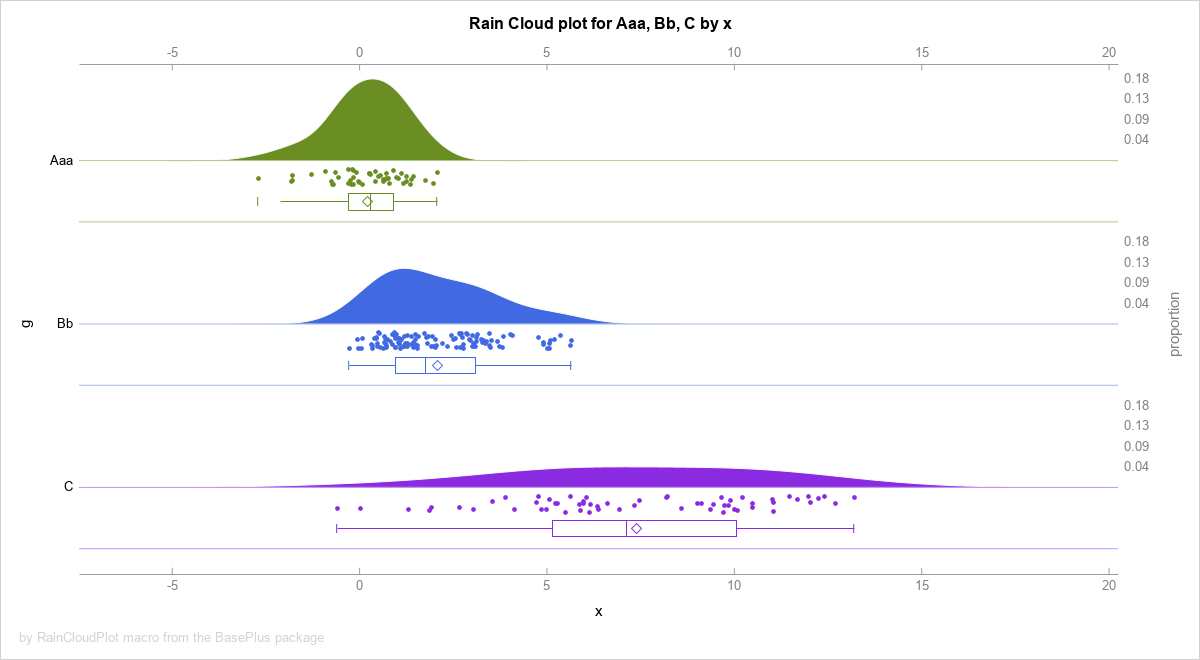
**EXAMPLE 2.** Rain Cloud plot for `sashelp.cars` dataset
with groups by Origin or Type
for Invoice variables:
~~~~~~~~~~~~~~~~~~~~~~~~~~~~~~~~~~~~~~~~~~~~~~~~~~~~~~~~~~~~~~~~sas
%RainCloudPlot(
sashelp.cars(where=(Type ne "Hybrid"))
, Origin Type
, Invoice
, HeightPX=300
, y2axisLevels=3
, catLabels=("Continent of Origin", "Car Type")
, xLabels="Invoice, [$]"
, xLabelAttrs=size=12 color=Pink weight=bold
)
~~~~~~~~~~~~~~~~~~~~~~~~~~~~~~~~~~~~~~~~~~~~~~~~~~~~~~~~~~~~~~~~
The output:
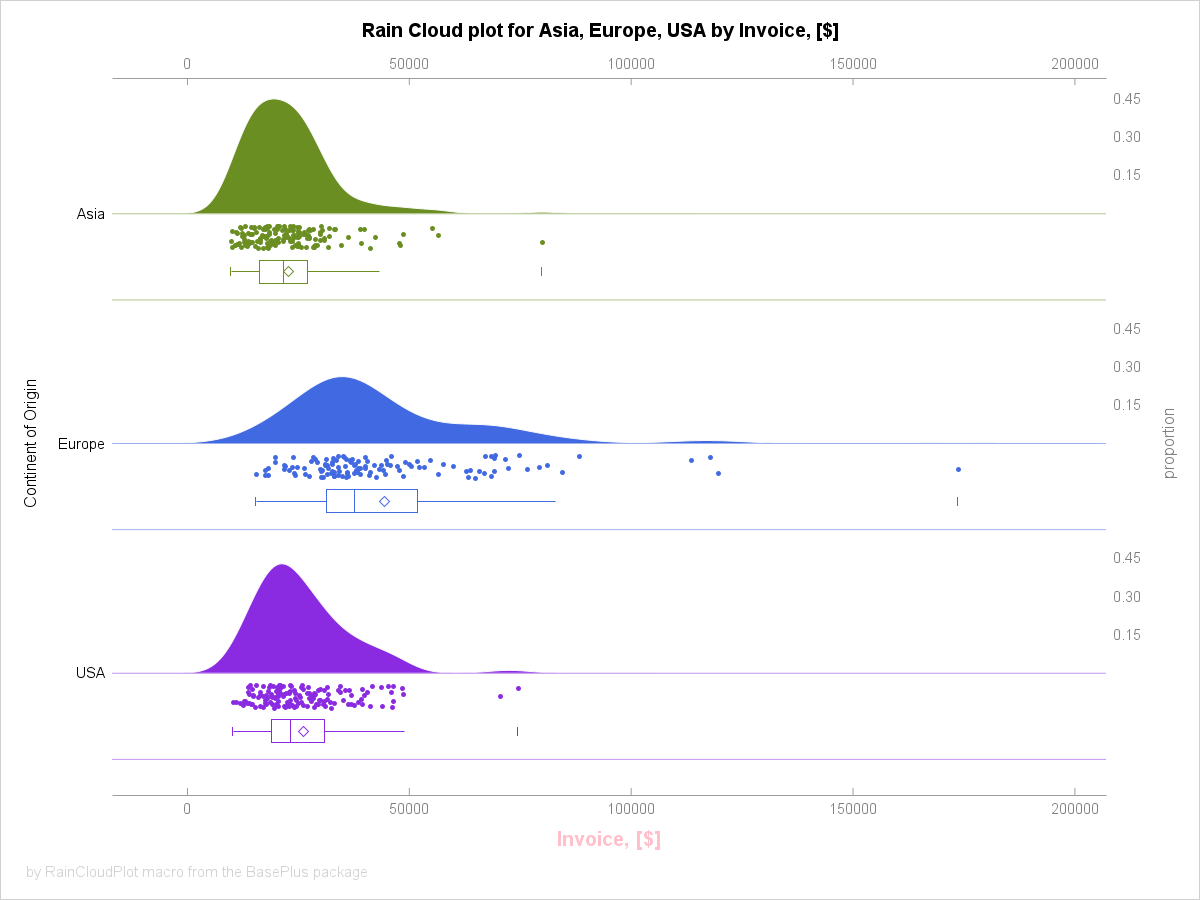
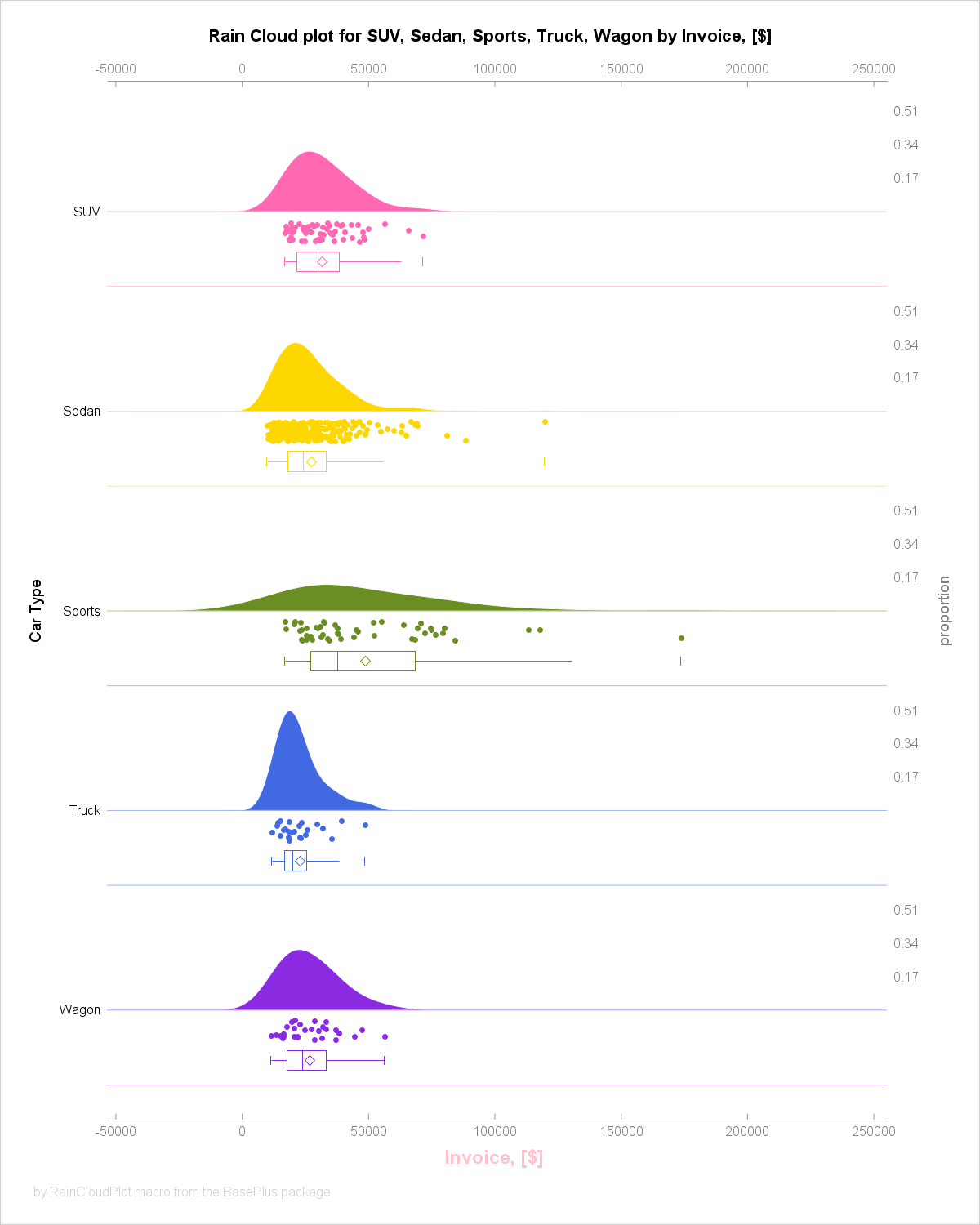
**EXAMPLE 3.** Rain Cloud plot with formatted groups
and annotations.
~~~~~~~~~~~~~~~~~~~~~~~~~~~~~~~~~~~~~~~~~~~~~~~~~~~~~~~~~~~~~~~~sas
data annotation;
function="text";
label="This graph is full(*ESC*){sup '2'} of annotations!";
drawspace="graphpercent";
rotate=30;
anchor="center";
textsize=32;
x1=50;
y1=50;
textcolor="red";
justify="center";
textweight="bold";
width=100;
widthunit="percent";
run;
proc format;
value system
1="Windows"
2="MacOS"
3="Linux"
;
run;
data test;
do system = 1 to 3;
do i = 1 to 50;
x = rannor(123)/system;
output;
end;
end;
format system system.;
run;
%RainCloudPlot(test, system, x
, colorslist=CX88CCEE CX44AA99 CX117733
, formated=1
, sganno=annotation
, sgPlotOptions=noborder
, WidthPX=1000
, HeightPX=320
, catAxisValueAttrs=Color=Green weight=bold
)
~~~~~~~~~~~~~~~~~~~~~~~~~~~~~~~~~~~~~~~~~~~~~~~~~~~~~~~~~~~~~~~~
The output:
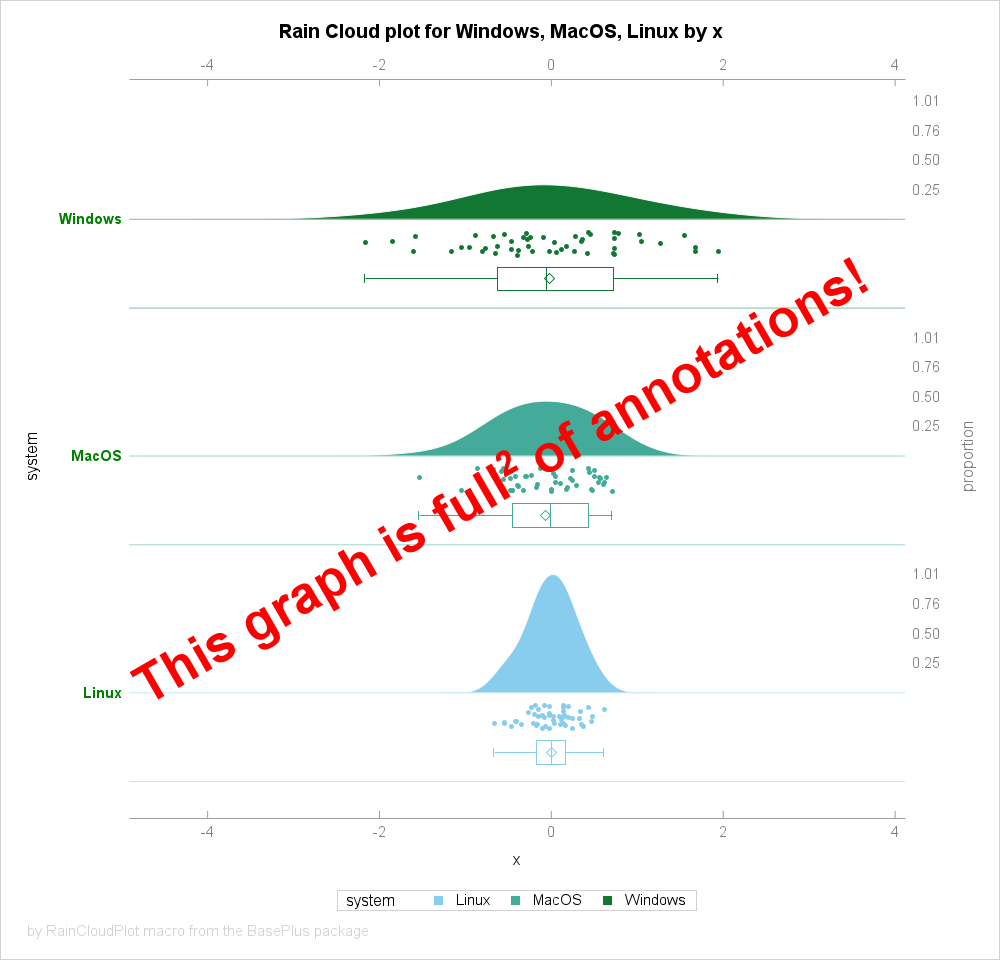
---
## >>> `%zipLibrary()` macro: <<< #######################
The zipLibrary() macro allows to zip content of a SAS library.
Files can be zipped into a single file (named as the input library)
or into multiple files (named as "dataset.sas7bdat.zip").
If a file is indexed also the index file is zipped.
Source files can be deleted after compression.
Status of compression and processing time is reported.
See examples below for the details.
### SYNTAX: ###################################################################
The basic syntax is the following, the `<...>` means optional parameters:
~~~~~~~~~~~~~~~~~~~~~~~sas
%zipLibrary(
lib
<,mode=>
<,clean=>
<,libOut=>
<,compression=>
)
~~~~~~~~~~~~~~~~~~~~~~~
**Arguments description**:
1. `lib` - *Required*, a name of the library to be zipped.
Must be a valid SAS V7, V8, or V9 library.
* `mode = S` - *Optional*, default value is `S`,
indicates mode of compression
generates single zip file (`SINGLE/S`)
or multiple files (`MULTI/M`)
* `clean = 0` - *Optional*, default value is `0`,
should datasets be deleted after zipping?
`1` means *yes*, `0` means *no*.
* `libOut =` - *Optional*, default value is empty,
output library for a single zip file.
* `compression =` - *Optional*, default value is `6`,
specifies the compression level
`0` to `9`, where `0` is no compression
and `9` is maximum compression.
### EXAMPLES AND USECASES: ####################################################
**EXAMPLE 1.** Generate data:
~~~~~~~~~~~~~~~~~~~~~~~~~~~~~~~~~~~~~~~~~~~~~~~~~~~~~~~~~~~~~~~~~~~~~~~~~~~~~~~~~~~~~sas
options dlcreatedir;
libname test1 "%sysfunc(pathname(work))/test1";
libname test2 "%sysfunc(pathname(work))/test2";
libname test3 (test1 test2);
libname test4 "%sysfunc(pathname(work))/test4";
options nodlcreatedir;
%put %sysfunc(pathname(test3));
%put %sysfunc(pathname(test4));
data
test1.A(index=(model))
test1.B
test2.C
test2.D(index=(model make io=(invoice origin)))
;
set sashelp.cars;
run;
data test1.B2 / view=test1.B2;
set test1.B;
output;
output;
run;
~~~~~~~~~~~~~~~~~~~~~~~~~~~~~~~~~~~~~~~~~~~~~~~~~~~~~~~~~~~~~~~~~~~~~~~~~~~~~~~~~~~~~
**EXAMPLE 2.** Zip content of test3 library
into the same location in one zip file:
~~~~~~~~~~~~~~~~~~~~~~~~~~~~~~~~~~~~~~~~~~~~~~~~~~~~~~~~~~~~~~~~~~~~~~~~~~~~~~~~~~~~~sas
%zipLibrary(test3)
~~~~~~~~~~~~~~~~~~~~~~~~~~~~~~~~~~~~~~~~~~~~~~~~~~~~~~~~~~~~~~~~~~~~~~~~~~~~~~~~~~~~~
**EXAMPLE 3.** Zip content of test3 library
into the same location in multiple zip files:
~~~~~~~~~~~~~~~~~~~~~~~~~~~~~~~~~~~~~~~~~~~~~~~~~~~~~~~~~~~~~~~~~~~~~~~~~~~~~~~~~~~~~sas
%zipLibrary(test3, mode=MULTI)
~~~~~~~~~~~~~~~~~~~~~~~~~~~~~~~~~~~~~~~~~~~~~~~~~~~~~~~~~~~~~~~~~~~~~~~~~~~~~~~~~~~~~
**EXAMPLE 4.** Zip content of test3 library
with maximum compression level
into different location in one zip file
and delete source files:
~~~~~~~~~~~~~~~~~~~~~~~~~~~~~~~~~~~~~~~~~~~~~~~~~~~~~~~~~~~~~~~~~~~~~~~~~~~~~~~~~~~~~sas
%zipLibrary(test3, clean=1, libOut=test4, compression=9)
~~~~~~~~~~~~~~~~~~~~~~~~~~~~~~~~~~~~~~~~~~~~~~~~~~~~~~~~~~~~~~~~~~~~~~~~~~~~~~~~~~~~~
---
## >>> `%unzipLibrary()` macro: <<< #######################
The unzipLibrary() macro allows to unzip content of a SAS library.
It is a *counterpart* to the `%zipLibrary()` macro and is *not* intended to work
with zip files generated by other software (though it may in some cases).
Files can be unzipped from a single file
or from multiple files (named e.g. "dataset.sas7bdat.zip").
If a file is indexed also the index file is unzipped.
Source files can be deleted after decompression.
Status of decompression and processing time is reported.
See examples below for the details.
### SYNTAX: ###################################################################
The basic syntax is the following, the `<...>` means optional parameters:
~~~~~~~~~~~~~~~~~~~~~~~sas
%unzipLibrary(
path
<,zip=>
<,mode=>
<,clean=>
<,libOut=>
)
~~~~~~~~~~~~~~~~~~~~~~~
**Arguments description**:
1. `path` - *Required*, a path pointing to zipped file(s) location.
* `zip =` - *Optional*, When `mode=S` a name of the
zip file containing SAS files to be unzipped.
* `mode = S` - *Optional*, default value is `S`,
indicates mode of decompression
read from a single zip file (`SINGLE/S`)
or from multiple files (`MULTI/M`)
* `clean = 0` - *Optional*, default value is `0`,
should zip files be deleted after unzipping?
`1` means *yes*, `0` means *no*.
* `libOut =` - *Optional*, default value is empty,
output library for a single zip file
decompression.
### EXAMPLES AND USECASES: ####################################################
**EXAMPLE 1.** Generate data:
~~~~~~~~~~~~~~~~~~~~~~~~~~~~~~~~~~~~~~~~~~~~~~~~~~~~~~~~~~~~~~~~~~~~~~~~~~~~~~~~~~~~~sas
options dlcreatedir;
libname test1 "%sysfunc(pathname(work))/test1";
libname test2 "%sysfunc(pathname(work))/test2";
libname test3 (test1 test2);
libname test4 "%sysfunc(pathname(work))/test4";
options nodlcreatedir;
%put %sysfunc(pathname(test3));
%put %sysfunc(pathname(test4));
data
test1.A(index=(model))
test1.B
test2.C
test2.D(index=(model make io=(invoice origin)))
;
set sashelp.cars;
run;
data test1.B2 / view=test1.B2;
set test1.B;
output;
output;
run;
~~~~~~~~~~~~~~~~~~~~~~~~~~~~~~~~~~~~~~~~~~~~~~~~~~~~~~~~~~~~~~~~~~~~~~~~~~~~~~~~~~~~~
**EXAMPLE 2.** Use data from Example 1.
First zip content of the `test3` library
to `test4` location into one zip file
and delete source files.
Next unzip `test3.zip` library into the
`test4` location and delete the zip file.
~~~~~~~~~~~~~~~~~~~~~~~~~~~~~~~~~~~~~~~~~~~~~~~~~~~~~~~~~~~~~~~~~~~~~~~~~~~~~~~~~~~~~sas
%zipLibrary(test3, clean=1, libOut=test4)
%unzipLibrary(%sysfunc(pathname(test4)), zip=test3, clean=1)
~~~~~~~~~~~~~~~~~~~~~~~~~~~~~~~~~~~~~~~~~~~~~~~~~~~~~~~~~~~~~~~~~~~~~~~~~~~~~~~~~~~~~
**EXAMPLE 3.** Use data from Example 1.
First zip content of the `test1` library
into multiple zip files and delete source files.
Next unzip `*.zip` files in `test1`
location and delete zipped files
~~~~~~~~~~~~~~~~~~~~~~~~~~~~~~~~~~~~~~~~~~~~~~~~~~~~~~~~~~~~~~~~~~~~~~~~~~~~~~~~~~~~~sas
%zipLibrary(test1, mode=M, clean=1)
%unzipLibrary(%sysfunc(pathname(test1)), mode=M, clean=1)
~~~~~~~~~~~~~~~~~~~~~~~~~~~~~~~~~~~~~~~~~~~~~~~~~~~~~~~~~~~~~~~~~~~~~~~~~~~~~~~~~~~~~
**EXAMPLE 4.** First zip content of the `sashelp` library
into `work` library.
Next unzip `sashelp.zip` file in `work`
location and delete zip file.
~~~~~~~~~~~~~~~~~~~~~~~~~~~~~~~~~~~~~~~~~~~~~~~~~~~~~~~~~~~~~~~~~~~~~~~~~~~~~~~~~~~~~sas
%zipLibrary(sashelp, mode=S, clean=0, libOut=work)
%unzipLibrary(%sysfunc(pathname(work)), zip=sashelp, mode=S, clean=1)
~~~~~~~~~~~~~~~~~~~~~~~~~~~~~~~~~~~~~~~~~~~~~~~~~~~~~~~~~~~~~~~~~~~~~~~~~~~~~~~~~~~~~
---
## >>> `%LDSN()` macro: <<< #######################
The LDSN (Long DataSet Names) macro function
allows to use an "arbitrary" text string to name a dataset.
The LDSN macro has some limitation described below, to overcome them
another macro, with different name: LDSNM (Long DataSet Names Modified)
was created. See its description to learn how to use it.
---
The idea for the macro came from the following story:
Good friend of mine, who didn't use SAS for quite some time,
told me that he lost a few hours for debugging because
he forgot that the SAS dataset name limitation is 32 bytes.
I replied that it shouldn't be a problem to do a workaround
for this inconvenience with a macro and the `MD5()` hashing function.
I said: *The macro should take an "arbitrary string" for a dataset
name, convert it, with help of `MD5()`, to a hash digest, and
create a dataset with an "artificial" `hex16.` formated name.*
Starting with something like this:
~~~~~~~~~~~~~~~~~~~~~~~sas
data %LDSN(work. peanut butter & jelly with a hot-dog in [a box] and s*t*a*r*s (drop = sex rename=(name=first_name) where = (age in (12,13,14))) );
set sashelp.class;
run;
~~~~~~~~~~~~~~~~~~~~~~~
the macro would do:
~~~~~~~~~~~~~~~~~~~~~~~sas
%sysfunc(MD5(peanut butter & jelly with a hot-dog in [a box] and s*t*a*r*s), hex16.)
~~~~~~~~~~~~~~~~~~~~~~~
and (under the hood) return and execute the following code:
~~~~~~~~~~~~~~~~~~~~~~~sas
data work.DSN_41D599EF51FBA58_(drop = sex rename=(name=first_name) where = (age in (12,13,14))) ;
set sashelp.class;
run;
~~~~~~~~~~~~~~~~~~~~~~~
Also in the next data step user should be able to do:
~~~~~~~~~~~~~~~~~~~~~~~sas
data my_next_data_step;
set %DSN(work. peanut butter & jelly with a hot-dog in [a box] and s*t*a*r*s);
run;
~~~~~~~~~~~~~~~~~~~~~~~
and work without the "dataset-name-length-limitation" issue.
---
See examples below for the details.
The `%LDSN()` macro executes like a pure macro code.
**Known "Limitations":**
- dataset name _cannot_ contain dots (`.`) since they are used as separators!
- dataset name _cannot_ contain round brackets(`(` and `)`) since they are used as separators
(but `[]` and `{}` are allowed)!
- dataset name _cannot_ contain unpaired quotes (`'` and `"`),
text: `a "hot-dog"` is ok, but `John's dog` is not!
**Behaviour:**
- dataset name text is *converted to upcase*
- dataset name text *leading and trailing spaces are ignored*,
e.g. the following will give the same hash digest:
`%ldsn(work.test)`, `%ldsn( work.test)`, `%ldsn(work.test )`,
`%ldsn(work .test)`, `%ldsn(work. test)`, `%ldsn(work . test)`.
- macro calls of the form:
`data %LDSN(); run;`, `data %LDSN( ); run;`, `data %LDSN( . ); run;` or even
`data %LDSN( . (keep=x)); run;` are resolved to empty string, so the result is
equivalent to `data; run;`
### SYNTAX: ###################################################################
The basic syntax is the following, the `<...>` means optional parameters:
~~~~~~~~~~~~~~~~~~~~~~~sas
%LDSN(
arbitrary text string (in line with limitations)
)
~~~~~~~~~~~~~~~~~~~~~~~
The text string is concider as *"fully qualified dataset name"*, i.e. macro
assumes it may contain library as prefix and data set options as sufix.
See the `%LDsNm()` macro for comparison.
---
### EXAMPLES AND USECASES: ####################################################
**EXAMPLE 1.**
~~~~~~~~~~~~~~~~~~~~~~~~~~~~~~~~~~~~~~~~~~~~~~~~~~~~~~~~~~~~~~~~sas
options nomprint source nomlogic nosymbolgen ls = max ps = max;
data %LDSN( work. peanut butter & jelly with a "Hot-Dog" in [a box], popcorn, and s*t*a*r*s (drop = sex rename=(name=first_name) where = (age in (12,13,14))) );
set sashelp.class;
run;
proc print data = %LDSN( work. peanut butter & jelly with a "Hot-Dog" in [a box], popcorn, and s*t*a*r*s );
run;
data MyNextDataset;
set %LDSN( work. peanut butter & jelly with a "Hot-Dog" in [a box], popcorn, and s*t*a*r*s );
where age > 12;
run;
~~~~~~~~~~~~~~~~~~~~~~~~~~~~~~~~~~~~~~~~~~~~~~~~~~~~~~~~~~~~~~~~~~~~~~~~~~~~~~~~~~~~~
---
## >>> `%LDSNM()` macro: <<< #######################
The LDSNM (Long DataSet Names Modified) macro function
allows to use an "arbitrary" text string to name a dataset.
The LDSN macro had some limitation (see its documentation), to overcome them
another `%LDSNM()` (Long DataSet Names Modified) macro was created.
The main idea behind the `%LDSNM()` is the same as for `%LDSN()` - see the description there.
---
The `%LDSNM()` macro works differently than the `%LDSN()` macro.
The `%LDSN()` macro assumes that *both* libname and dataset options *are*
be passed as elements **inside** the macro argument, together with the data set name. E.g.
~~~~~~~~~~~~~~~~~~~~~~~~~~~~~~~~~~~~~~~~~~~~~~~~~~~~~~~~~~~~~~~~~~~~~~~~~~~~~~~~~~~~~~~~~~~~~~~~~~~~~~~~~~~~~~~~~~~sas
data %LDSN( WORK.peanut butter & jelly with a hot-dog in [a box] and s*t*a*r*s (drop = sex) );
set sashelp.class;
run;
~~~~~~~~~~~~~~~~~~~~~~~~~~~~~~~~~~~~~~~~~~~~~~~~~~~~~~~~~~~~~~~~~~~~~~~~~~~~~~~~~~~~~~~~~~~~~~~~~~~~~~~~~~~~~~~~~~~
The `%LDSNM()` macro, in contrary, assumes that both libname and dataset options are
passed **outside** the macro parameter, i.e.
~~~~~~~~~~~~~~~~~~~~~~~~~~~~~~~~~~~~~~~~~~~~~~~~~~~~~~~~~~~~~~~~~~~~~~~~~~~~~~~~~~~~~~~~~~~~~~~~~~~~~~~~~~~~~~~~~~~sas
data WORK.%LDSNM( peanut butter & jelly with a hot-dog in [a box] and s*t*a*r*s ) (drop = sex);
set sashelp.class;
run;
~~~~~~~~~~~~~~~~~~~~~~~~~~~~~~~~~~~~~~~~~~~~~~~~~~~~~~~~~~~~~~~~~~~~~~~~~~~~~~~~~~~~~~~~~~~~~~~~~~~~~~~~~~~~~~~~~~~
This approach overcomes some limitations the LDSN has.
The **additional** feature of the `%LDSNM()` is that when the macro is called,
a global macrovariable is created.
The macro variable name is the text of the hashed data set name.
The macro variable value is the text of the unhashed data set name (i.e. the argument of the macro).
For example the following macro call:
~~~~~~~~~~~~~~~~~~~~~~~~~~~~~~~~~~~~~~~~~~~~~~sas
data %LDSNM(John "x" 'y' dog);
set sashelp.class;
where name = 'John';
run;
~~~~~~~~~~~~~~~~~~~~~~~~~~~~~~~~~~~~~~~~~~~~~~
creates macro variable with name `DSN_BF1F8C4D6495B34A_` and with value: `JOHN "X" 'Y' DOG`.
The macrovariable is useful when combined with `symget()` function and
the `indsname=` option to get the original text string value back,
like in this example:
~~~~~~~~~~~~~~~~~~~~~~~~~~~~~~~~~~~~~~~~~~~~~~sas
data test;
set %LDSNM(John "x" 'y' dog) indsname = i;
indsname = symget(scan(i,-1,"."));
run;
~~~~~~~~~~~~~~~~~~~~~~~~~~~~~~~~~~~~~~~~~~~~~~
See examples below for the details.
---
The `%LDSN()` macro executes like a pure macro code.
**Known "Limitations":**
- dataset name _cannot_ contain _unpaired_ round brackets(`(` and `)`)
(but unmatched `[]` and `{}` are allowed)!
- dataset name _cannot_ contain _unpaired_ quotes (`'` and `"`),
text: `a "hot-dog"` is ok, but `John's dog` is not!
**Behaviour:**
- dataset name text is *converted to upcase*
- dataset name text *leading and trailing spaces are ignored*,
e.g. the following will give the same hash digest:
`%ldsn(test)`, `%ldsn( test)`, `%ldsn(test )`.
- macro calls of the form:
`data %LDSN(); run;` or `data %LDSN( ); run;` are resolved
to empty string, so the result is equivalent to `data; run;`
- created macrovariable is _global_ in scope.
### SYNTAX: ###################################################################
The basic syntax is the following, the `<...>` means optional parameters:
~~~~~~~~~~~~~~~~~~~~~~~sas
%LDSNM(
arbitrary text string (in line with limitations)
)
~~~~~~~~~~~~~~~~~~~~~~~
The text string is considered as *"only dataset name"*, i.e. the macro does not
assume it contains library as prefix or data set options as suffix.
See the `%LDSN()` macro for comparison.
---
### EXAMPLES AND USECASES: ####################################################
**EXAMPLE 1.**
~~~~~~~~~~~~~~~~~~~~~~~~~~~~~~~~~~~~~~~~~~~~~~~~~~~~~~~~~~~~~~~~sas
data %LDSNM(John "x" 'y' & dog);
set sashelp.class;
where name = 'John';
run;
data %LDSNM(John "x"[ 'y' & dog);
set sashelp.class;
where name = 'John';
run;
data %LDSNM(John "x" 'y'} & dog);
set sashelp.class;
where name = 'John';
run;
~~~~~~~~~~~~~~~~~~~~~~~~~~~~~~~~~~~~~~~~~~~~~~~~~~~~~~~~~~~~~~~~
**EXAMPLE 2.**
~~~~~~~~~~~~~~~~~~~~~~~~~~~~~~~~~~~~~~~~~~~~~~~~~~~~~~~~~~~~~~~~sas
data work.%LDsNm( peanut butter & jelly, a hot-dog in [a box], and s(*)t(*)a(*)r(*)s!! ) (drop = sex rename=(name=first_name) where = (age in (12,13,14)))
;
set sashelp.class;
run;
data test;
set work.%LDsNm( peanut butter & jelly, a hot-dog in [a box], and s(*)t(*)a(*)r(*)s!! ) indsname=i;
indsname=symget(scan(i,-1,"."));
run;
~~~~~~~~~~~~~~~~~~~~~~~~~~~~~~~~~~~~~~~~~~~~~~~~~~~~~~~~~~~~~~~~
**EXAMPLE 3.**
~~~~~~~~~~~~~~~~~~~~~~~~~~~~~~~~~~~~~~~~~~~~~~~~~~~~~~~~~~~~~~~~sas
data work.%LDsNm( . );
set sashelp.class;
run;
data %LDsNm( );
set sashelp.class;
run;
data %LDsNm();
set sashelp.class;
run;
~~~~~~~~~~~~~~~~~~~~~~~~~~~~~~~~~~~~~~~~~~~~~~~~~~~~~~~~~~~~~~~~~~~~~~~~~~~~~~~~~~~~~
---
## >>> `%LVarNm()` macro: <<< #######################
The LVarNm() macro function works like the LDSN() macro function, but for variables.
Supported by LVarNmLab() macro function which allows to remember "user names" in labels.
The motivation for the macro was similar to that for the LDSN() macro.
---
See examples below for the details.
The `%LVarNm()` macro executes like a pure macro code.
**Known "Limitations":**
- variable name _cannot_ contain unpaired quotes (`'` and `"`),
text: `a "hot-dog"` is ok, but `John's dog` is not!
**Behaviour:**
- variable name text is *converted to upcase*
- variable name text *leading and trailing spaces are ignored*,
e.g. the following will give the same hash digest:
`%LVarNm(test)`, `%LVarNm( test)`, `%LVarNm(test )`.
### SYNTAX: ###################################################################
The basic syntax is the following, the `<...>` means optional parameters:
~~~~~~~~~~~~~~~~~~~~~~~sas
%LVarNm(
arbitrary text string (in line with limitations)
)
~~~~~~~~~~~~~~~~~~~~~~~
---
### EXAMPLES AND USE CASES: ####################################################
**EXAMPLE 1.**
~~~~~~~~~~~~~~~~~~~~~~~~~~~~~~~~~~~~~~~~~~~~~~~~~~~~~~~~~~~~~~~~sas
options ls=max;
data test;
%LVarNmLab( peanut butter & jelly with a "Hot-Dog" in [a box], popcorn, and s*t*a*r*s )
do %LVarNm( peanut butter & jelly with a "Hot-Dog" in [a box], popcorn, and s*t*a*r*s ) = 1 to 10;
y = 5 + %LVarNm( peanut butter & jelly with a "Hot-Dog" in [a box], popcorn, and s*t*a*r*s ) * 17;
output;
end;
run;
data test2;
set test;
where %LVarNm( peanut butter & jelly with a "Hot-Dog" in [a box], popcorn, and s*t*a*r*s ) < 5;
run;
~~~~~~~~~~~~~~~~~~~~~~~~~~~~~~~~~~~~~~~~~~~~~~~~~~~~~~~~~~~~~~~~
**EXAMPLE 2.**
~~~~~~~~~~~~~~~~~~~~~~~~~~~~~~~~~~~~~~~~~~~~~~~~~~~~~~~~~~~~~~~~sas
data test3;
%LVarNmLab() = 17;
%LVarNm() = 17;
%LVarNm( ) = 42;
%LVarNm( ) = 303;
run;
~~~~~~~~~~~~~~~~~~~~~~~~~~~~~~~~~~~~~~~~~~~~~~~~~~~~~~~~~~~~~~~~
**EXAMPLE 3.**
~~~~~~~~~~~~~~~~~~~~~~~~~~~~~~~~~~~~~~~~~~~~~~~~~~~~~~~~~~~~~~~~sas
data test3;
%LVarNm(test) = 1;
%LVarNm( test) = 2;
%LVarNm(test ) = 3;
run;
~~~~~~~~~~~~~~~~~~~~~~~~~~~~~~~~~~~~~~~~~~~~~~~~~~~~~~~~~~~~~~~~
**EXAMPLE 4.**
~~~~~~~~~~~~~~~~~~~~~~~~~~~~~~~~~~~~~~~~~~~~~~~~~~~~~~~~~~~~~~~~sas
data test4;
array X[*] %LVarNm(some strange! name)_0 - %LVarNm(some strange! name)_10;
do i = lbound(X) to hbound(X);
X[i] = 2**(i-1);
put X[i]=;
end;
run;
~~~~~~~~~~~~~~~~~~~~~~~~~~~~~~~~~~~~~~~~~~~~~~~~~~~~~~~~~~~~~~~~
## >>> `%LVarNmLab()` macro: <<< #######################
The LVarNmLab() macro function supports LVarNm() and allows to remember "user names" in labels.
The motivation for the macro was similar one as for the LDSN() macro.
---
See examples in LVarNm() documentation for the details.
The `%LVarNmLab()` macro executes like a pure macro code.
**Known "Limitations":**
- variable name _cannot_ contain unpaired quotes (`'` and `"`),
text: `a "hot-dog"` is ok, but `John's dog` is not!
**Behaviour:**
- variable name text is *converted to upcase*
- variable name text *leading and trailing spaces are ignored*,
e.g. the following will give the same hash digest:
`%LVarNmLab(test)`, `%LVarNmLab( test)`, `%LVarNmLab(test )`.
### SYNTAX: ###################################################################
The basic syntax is the following, the `<...>` means optional parameters:
~~~~~~~~~~~~~~~~~~~~~~~sas
%LVarNmLab(
arbitrary text string (in line with limitations)
)
~~~~~~~~~~~~~~~~~~~~~~~
---
## >>> `%bpPIPE()` macro: <<< #######################
The bpPIPE() [Base Plus PIPE] macro executes OS command
and print to the log output of the execution.
Under the hood it uses `_` filename reference to PIPE device.
### SYNTAX: ###################################################################
The basic syntax is the following, the `<...>` means optional parameters:
~~~~~~~~~~~~~~~~~~~~~~~sas
%bpPIPE( )
~~~~~~~~~~~~~~~~~~~~~~~
**Arguments description**:
* **NO Arguments** - Everything inside brackets is treated as an OS command.
---
### EXAMPLES AND USECASES: ####################################################
**EXAMPLE 1.** List, to the log, content of D and C drives:
~~~~~~~~~~~~~~~~~~~~~~~~~~~~~~~~~~~~~~~~~~~~~~~~~~~~~~~~~~~~~~~~sas
%bpPIPE(D: & dir & dir "C:\")
~~~~~~~~~~~~~~~~~~~~~~~~~~~~~~~~~~~~~~~~~~~~~~~~~~~~~~~~~~~~~~~~
**EXAMPLE 2.** List, to the log, content of `home` directory:
~~~~~~~~~~~~~~~~~~~~~~~~~~~~~~~~~~~~~~~~~~~~~~~~~~~~~~~~~~~~~~~~sas
%bpPIPE(ls -halt ~/)
~~~~~~~~~~~~~~~~~~~~~~~~~~~~~~~~~~~~~~~~~~~~~~~~~~~~~~~~~~~~~~~~
---
## >>> `%dirsAndFiles()` macro: <<< #######################
The `%dirsAndFiles()` macro allows to extract info about all files
and subdirectories of a given `root` directory.
The extracted info may be just a list of files and subdirectories or, if
the `details=` parameter is set to 1, additional operating system information
is extracted (information is OSS dependent and gives different results for Linux
and for Windows)
The extracted info can be narrowed down to files (`keepFiles=1`) or to
directories (`keepDirs=1`) if need be.
The extracted info can be presented in wide or long format (`longFormat=1`).
The extracted info for files can be narrowed down to only files with particular
extension, for example: `fileExt=sas7bdat`.
The extracted info can be narrowed down maximal path depth
by setting up the `maxDepth=` parameter.
See examples below for the details.
### REFERENCES: ###################################################################
The macro is based on Kurt Bremser's "*Talking to Your Host*" article
presented at WUSS 2022 conference.
The article is available [here](https://communities.sas.com/t5/SAS-User-Groups-Library/WUSS-Presentation-Talking-to-Your-Host/ta-p/838344)
and also as an additional content of this package.
The paper was awarded the "Best Paper Award - Programming".
### SYNTAX: ###################################################################
The basic syntax is the following, the `<...>` means optional parameters:
~~~~~~~~~~~~~~~~~~~~~~~sas
%dirsAndFiles(
root
<,ODS=>
<,details=>
<,keepDirs=>
<,keepFiles=>
<,longFormat=>
<,fileExt=>
<,maxDepth=>
)
~~~~~~~~~~~~~~~~~~~~~~~
**Arguments description**:
1. `root` - *Required*, path to be searched
for information.
* `ODS=work.dirsAndFilesInfo` - *Optional*, output data set,
name of a dataset to store information.
* `details=0` - *Optional*, indicates if detailed info
will be collected, `1` = yes, `0` = no.
* `keepDirs=1` - *Optional*, indicates if directories info
will be collected, `1` = yes, `0` = no.
* `keepFiles=1` - *Optional*, indicates if files info
will be collected, `1` = yes, `0` = no.
* `longFormat=0` - *Optional*, indicates if output be
in long format, `1` = yes, `0` = no.
* `fileExt=` - *Optional*, if not missing then indicates
file extension to filter out results.
* `maxDepth=0` - *Optional*, if not zero then indicates
maximum depth of search in the root path.
---
### EXAMPLES AND USECASES: ####################################################
**EXAMPLE 1.** Get list of files and directories:
~~~~~~~~~~~~~~~~~~~~~~~~~~~~~~~~~~~~~~~~~~~~~~~~~~~~~~~~~~~~~~~~~~~~~~~~~~~~~~~~~~~~~sas
%dirsAndFiles(C:\SAS_WORK\,ODS=work.result1)
~~~~~~~~~~~~~~~~~~~~~~~~~~~~~~~~~~~~~~~~~~~~~~~~~~~~~~~~~~~~~~~~~~~~~~~~~~~~~~~~~~~~~
**EXAMPLE 2.** Get detailed info:
~~~~~~~~~~~~~~~~~~~~~~~~~~~~~~~~~~~~~~~~~~~~~~~~~~~~~~~~~~~~~~~~~~~~~~~~~~~~~~~~~~~~~sas
%dirsAndFiles(C:\SAS_WORK\,ODS=work.result2,details=1)
~~~~~~~~~~~~~~~~~~~~~~~~~~~~~~~~~~~~~~~~~~~~~~~~~~~~~~~~~~~~~~~~~~~~~~~~~~~~~~~~~~~~~
**EXAMPLE 3.** Get only files info:
~~~~~~~~~~~~~~~~~~~~~~~~~~~~~~~~~~~~~~~~~~~~~~~~~~~~~~~~~~~~~~~~~~~~~~~~~~~~~~~~~~~~~sas
%dirsAndFiles(C:\SAS_WORK\,ODS=work.result3,keepDirs=0)
%dirsAndFiles(C:\SAS_WORK\,ODS=work.result5,keepDirs=0,details=1)
~~~~~~~~~~~~~~~~~~~~~~~~~~~~~~~~~~~~~~~~~~~~~~~~~~~~~~~~~~~~~~~~~~~~~~~~~~~~~~~~~~~~~
**EXAMPLE 4.** Get only directories info:
~~~~~~~~~~~~~~~~~~~~~~~~~~~~~~~~~~~~~~~~~~~~~~~~~~~~~~~~~~~~~~~~~~~~~~~~~~~~~~~~~~~~~sas
%dirsAndFiles(C:\SAS_WORK\,ODS=work.result4,keepFiles=0)
%dirsAndFiles(C:\SAS_WORK\,ODS=work.result6,keepFiles=0,details=1)
~~~~~~~~~~~~~~~~~~~~~~~~~~~~~~~~~~~~~~~~~~~~~~~~~~~~~~~~~~~~~~~~~~~~~~~~~~~~~~~~~~~~~
**EXAMPLE 5.** Filter out by `sas` extension:
~~~~~~~~~~~~~~~~~~~~~~~~~~~~~~~~~~~~~~~~~~~~~~~~~~~~~~~~~~~~~~~~~~~~~~~~~~~~~~~~~~~~~sas
%dirsAndFiles(~/,ODS=work.result7,fileExt=sas)
%dirsAndFiles(~/,ODS=work.result8,fileExt=sas,details=1)
~~~~~~~~~~~~~~~~~~~~~~~~~~~~~~~~~~~~~~~~~~~~~~~~~~~~~~~~~~~~~~~~~~~~~~~~~~~~~~~~~~~~~
**EXAMPLE 6.** Keep result in the long format:
~~~~~~~~~~~~~~~~~~~~~~~~~~~~~~~~~~~~~~~~~~~~~~~~~~~~~~~~~~~~~~~~~~~~~~~~~~~~~~~~~~~~~sas
%dirsAndFiles(~/,ODS=work.result9,details=1,longFormat=1)
~~~~~~~~~~~~~~~~~~~~~~~~~~~~~~~~~~~~~~~~~~~~~~~~~~~~~~~~~~~~~~~~~~~~~~~~~~~~~~~~~~~~~
**EXAMPLE 7.** Get info for maximum depth of 2:
~~~~~~~~~~~~~~~~~~~~~~~~~~~~~~~~~~~~~~~~~~~~~~~~~~~~~~~~~~~~~~~~~~~~~~~~~~~~~~~~~~~~~sas
%dirsAndFiles(C:\SAS_WORK\,ODS=work.result10,details=1,maxDepth=2)
~~~~~~~~~~~~~~~~~~~~~~~~~~~~~~~~~~~~~~~~~~~~~~~~~~~~~~~~~~~~~~~~~~~~~~~~~~~~~~~~~~~~~
**EXAMPLE 8.** How locked/unavailable files are handled:
~~~~~~~~~~~~~~~~~~~~~~~~~~~~~~~~~~~~~~~~~~~~~~~~~~~~~~~~~~~~~~~~~~~~~~~~~~~~~~~~~~~~~sas
%dirsAndFiles(%sysfunc(pathname(WORK)),ODS=work.result11,details=1)
~~~~~~~~~~~~~~~~~~~~~~~~~~~~~~~~~~~~~~~~~~~~~~~~~~~~~~~~~~~~~~~~~~~~~~~~~~~~~~~~~~~~~
**EXAMPLE 9.** Not existing directory:
~~~~~~~~~~~~~~~~~~~~~~~~~~~~~~~~~~~~~~~~~~~~~~~~~~~~~~~~~~~~~~~~~~~~~~~~~~~~~~~~~~~~~sas
%dirsAndFiles(%sysfunc(pathname(WORK))/noSuchDir,ODS=work.result12,details=1)
~~~~~~~~~~~~~~~~~~~~~~~~~~~~~~~~~~~~~~~~~~~~~~~~~~~~~~~~~~~~~~~~~~~~~~~~~~~~~~~~~~~~~
---
## >>> `%repeatTxt()` macro: <<< #######################
The repeatTxt() macro function allows to repeat `n`
times a `text` string separated by string `s=`.
The repeatTxt() returns unquoted value [by %unquote()].
See examples below for the details.
The `%repeatTxt()` macro executes like a pure macro code.
### SYNTAX: ###################################################################
The basic syntax is the following, the `<...>` means optional parameters:
~~~~~~~~~~~~~~~~~~~~~~~sas
%repeatTxt(
text
<,n>
<,s=>
)
~~~~~~~~~~~~~~~~~~~~~~~
**Arguments description**:
1. `text` - *Required*, a text to be repeated.
2. `n` - *Required/Optional*, the number of repetitions.
If missing then set to `1`;
* `s = %str( )` - *Optional*, it is a separator between
repeated elements. Default value is space.
---
### EXAMPLES AND USECASES: ####################################################
**EXAMPLE 1.** Simple repetition of dataset name:
~~~~~~~~~~~~~~~~~~~~~~~~~~~~~~~~~~~~~~~~~~~~~~~~~~~~~~~~~~~~~~~~~~~~~~~~~~~~~~~~~~~~~sas
options mprint;
data work.test5;
set
%repeatTxt(sashelp.cars, 5)
;
run;
~~~~~~~~~~~~~~~~~~~~~~~~~~~~~~~~~~~~~~~~~~~~~~~~~~~~~~~~~~~~~~~~~~~~~~~~~~~~~~~~~~~~~
**EXAMPLE 2.** Simple repetition of data step:
~~~~~~~~~~~~~~~~~~~~~~~~~~~~~~~~~~~~~~~~~~~~~~~~~~~~~~~~~~~~~~~~~~~~~~~~~~~~~~~~~~~~~sas
options mprint;
%repeatTxt(data _null_; set sashelp.cars; run;, 3)
~~~~~~~~~~~~~~~~~~~~~~~~~~~~~~~~~~~~~~~~~~~~~~~~~~~~~~~~~~~~~~~~~~~~~~~~~~~~~~~~~~~~~
**EXAMPLE 3.** "Nice" output:
~~~~~~~~~~~~~~~~~~~~~~~~~~~~~~~~~~~~~~~~~~~~~~~~~~~~~~~~~~~~~~~~~~~~~~~~~~~~~~~~~~~~~sas
%put %repeatTxt(#,15,s=$) HELLO SAS! %repeatTxt(#,15,s=$);
~~~~~~~~~~~~~~~~~~~~~~~~~~~~~~~~~~~~~~~~~~~~~~~~~~~~~~~~~~~~~~~~~~~~~~~~~~~~~~~~~~~~~
**EXAMPLE 4.** Macroquote a text with commas:
~~~~~~~~~~~~~~~~~~~~~~~~~~~~~~~~~~~~~~~~~~~~~~~~~~~~~~~~~~~~~~~~~~~~~~~~~~~~~~~~~~~~~sas
%repeatTxt(
%str(proc sql; create table wh as select weight,height from sashelp.class; quit;)
,3
)
~~~~~~~~~~~~~~~~~~~~~~~~~~~~~~~~~~~~~~~~~~~~~~~~~~~~~~~~~~~~~~~~~~~~~~~~~~~~~~~~~~~~~
**EXAMPLE 5.** Empty `n` repeats `text` one time:
~~~~~~~~~~~~~~~~~~~~~~~~~~~~~~~~~~~~~~~~~~~~~~~~~~~~~~~~~~~~~~~~~~~~~~~~~~~~~~~~~~~~~sas
options mprint;
data work.test1;
set
%repeatTxt(sashelp.cars)
;
run;
~~~~~~~~~~~~~~~~~~~~~~~~~~~~~~~~~~~~~~~~~~~~~~~~~~~~~~~~~~~~~~~~~~~~~~~~~~~~~~~~~~~~~
**EXAMPLE 6.** Dynamic "formatting":
~~~~~~~~~~~~~~~~~~~~~~~~~~~~~~~~~~~~~~~~~~~~~~~~~~~~~~~~~~~~~~~~~~~~~~~~~~~~~~~~~~~~~sas
%macro printWork();
%let work=%sysfunc(pathname(work));
%put +%repeatTxt(~,%length(&work.)+5,s=)+;
%put {&=work.};
%put +%repeatTxt(~,%length(&work.)+5,s=)+;
%mend printWork;
%printWork()
~~~~~~~~~~~~~~~~~~~~~~~~~~~~~~~~~~~~~~~~~~~~~~~~~~~~~~~~~~~~~~~~~~~~~~~~~~~~~~~~~~~~~
---
## >>> `%intsList()` macro: <<< #######################
The intsList() macro function allows to print a list of
integers starting from `start` up to `end` incremented by `by`
and separated by `sep=`.
If `start`, `end` or `by` are non-integers the are converted to integers.
See examples below for the details.
The `%intsList()` macro executes like a pure macro code.
### SYNTAX: ###################################################################
The basic syntax is the following, the `<...>` means optional parameters:
~~~~~~~~~~~~~~~~~~~~~~~sas
%intsList(
start
<,end>
<,by>
<,sep=>
)
~~~~~~~~~~~~~~~~~~~~~~~
**Arguments description**:
1. `start` - *Required*, the first value of the list.
If `end` is missing then the list is generated
from 1 to `start` by 1.
2. `end` - *Required/Optional*, the last value of the list.
3. `by` - *Required/Optional*, the increment of the list.
If missing then set to `1`.
*Cannot* be equal to `0`.
* `s = %str( )` - *Optional*, it is a separator between
elements of the list. Default value is space.
---
### EXAMPLES AND USECASES: ####################################################
**EXAMPLE 1.** Simple list of integers from 1 to 10 by 1:
~~~~~~~~~~~~~~~~~~~~~~~~~~~~~~~~~~~~~~~~~~~~~~~~~~~~~~~~~~~~~~~~~~~~~~~~~~~~~~~~~~~~~sas
%put %intsList(10);
~~~~~~~~~~~~~~~~~~~~~~~~~~~~~~~~~~~~~~~~~~~~~~~~~~~~~~~~~~~~~~~~~~~~~~~~~~~~~~~~~~~~~
**EXAMPLE 2.** Ten copies of `sashelp.class` in `test11` to `test20`:
~~~~~~~~~~~~~~~~~~~~~~~~~~~~~~~~~~~~~~~~~~~~~~~~~~~~~~~~~~~~~~~~~~~~~~~~~~~~~~~~~~~~~sas
data
%zipEvalf(test, %intsList(11,20))
;
set sashelp.class;
run;
~~~~~~~~~~~~~~~~~~~~~~~~~~~~~~~~~~~~~~~~~~~~~~~~~~~~~~~~~~~~~~~~~~~~~~~~~~~~~~~~~~~~~
**EXAMPLE 3.** Non-integers are converted to integers, the list is `1 3 5`:
~~~~~~~~~~~~~~~~~~~~~~~~~~~~~~~~~~~~~~~~~~~~~~~~~~~~~~~~~~~~~~~~~~~~~~~~~~~~~~~~~~~~~sas
%put %intsList(1.1,5.2,2.3);
~~~~~~~~~~~~~~~~~~~~~~~~~~~~~~~~~~~~~~~~~~~~~~~~~~~~~~~~~~~~~~~~~~~~~~~~~~~~~~~~~~~~~
**EXAMPLE 4.** A list with a separator:
~~~~~~~~~~~~~~~~~~~~~~~~~~~~~~~~~~~~~~~~~~~~~~~~~~~~~~~~~~~~~~~~~~~~~~~~~~~~~~~~~~~~~sas
%put %intsList(1,5,2,sep=+);
~~~~~~~~~~~~~~~~~~~~~~~~~~~~~~~~~~~~~~~~~~~~~~~~~~~~~~~~~~~~~~~~~~~~~~~~~~~~~~~~~~~~~
---
## >>> `%letters()` macro: <<< #######################
The letters() macro function allows to print a list of Roman
letters starting from `start` up to `end` incremented by `by`.
The letters list can be uppercases or lowercase (parameter `c=U` or `c=L`),
can be quoted (e.g. `q=""` or `q=[]`), and can be separated by `s=`.
Values of `start`, `end`, and `by` have to be integers in range between 1 ad 26.
See examples below for the details.
The `%letters()` macro executes like a pure macro code.
### SYNTAX: ###################################################################
The basic syntax is the following, the `<...>` means optional parameters:
~~~~~~~~~~~~~~~~~~~~~~~sas
%letters(
range
<,c=>
<,q=>
<,s=>
)
~~~~~~~~~~~~~~~~~~~~~~~
**Arguments description**:
1. `range` - *Required*, letters selector in form `start:end:by`.
Lists letters from `start` to `end` by `by`.
Values of `start`, `end`, and `by` are separated by
colon and must be between 1 ad 26.
If value is outside range it is set to
`start=1`, `en=26`, and `by=1`. If `end` is missing
then is set to value of `start`.
If `end` is smaller than `start` list is reversed
* `c = U` - *Optional*, it is a lowercase letters indicator.
Select `L` or `l`. Default value is `U` for upcase.
* `q = ` - *Optional*, it is a quite around elements of the list.
Default value is empty. Use `%str()` for one quote symbol.
If there are multiple symbols, only the first and the
second are selected as a preceding and trailing one,
e.g. `q=[]` gives `[A] [B] ... [Z]`.
* `s = %str( )` - *Optional*, it is a separator between
elements of the list. Default value is space.
---
### EXAMPLES AND USECASES: ####################################################
**EXAMPLE 1.** Space separated list of capital letters from A to Z:
~~~~~~~~~~~~~~~~~~~~~~~~~~~~~~~~~~~~~~~~~~~~~~~~~~~~~~~~~~~~~~~~~~~~~~~~~~~~~~~~~~~~~sas
%put %letters(1:26:1);
%put %letters();
~~~~~~~~~~~~~~~~~~~~~~~~~~~~~~~~~~~~~~~~~~~~~~~~~~~~~~~~~~~~~~~~~~~~~~~~~~~~~~~~~~~~~
**EXAMPLE 2.** First, thirteenth, and last letter:
~~~~~~~~~~~~~~~~~~~~~~~~~~~~~~~~~~~~~~~~~~~~~~~~~~~~~~~~~~~~~~~~~~~~~~~~~~~~~~~~~~~~~sas
%put %letters(1) %letters(13) %letters(26);
~~~~~~~~~~~~~~~~~~~~~~~~~~~~~~~~~~~~~~~~~~~~~~~~~~~~~~~~~~~~~~~~~~~~~~~~~~~~~~~~~~~~~
**EXAMPLE 3.** Every third lowercase letter, i.e. `a d g j m p s v y`:
~~~~~~~~~~~~~~~~~~~~~~~~~~~~~~~~~~~~~~~~~~~~~~~~~~~~~~~~~~~~~~~~~~~~~~~~~~~~~~~~~~~~~sas
%put %letters(1:26:3,c=L);
~~~~~~~~~~~~~~~~~~~~~~~~~~~~~~~~~~~~~~~~~~~~~~~~~~~~~~~~~~~~~~~~~~~~~~~~~~~~~~~~~~~~~
**EXAMPLE 4.** Lists with separators:
~~~~~~~~~~~~~~~~~~~~~~~~~~~~~~~~~~~~~~~~~~~~~~~~~~~~~~~~~~~~~~~~~~~~~~~~~~~~~~~~~~~~~sas
%put %letters(1:26:2,s=#);
%put %letters(1:26:3,s=%str(;));
%put %letters(1:26:4,s=%str(,));
%put %letters(1:26,s=);
%put %letters(1:26,s==);
%put %letters(1:26,s=/);
~~~~~~~~~~~~~~~~~~~~~~~~~~~~~~~~~~~~~~~~~~~~~~~~~~~~~~~~~~~~~~~~~~~~~~~~~~~~~~~~~~~~~
**EXAMPLE 5.** Every second letter with quotes:
~~~~~~~~~~~~~~~~~~~~~~~~~~~~~~~~~~~~~~~~~~~~~~~~~~~~~~~~~~~~~~~~~~~~~~~~~~~~~~~~~~~~~sas
%put %letters(1:26:2,q=%str(%'));
%put %letters(2:26:2,q=%str(%"));
%put %letters(1:26:2,q='');
%put %letters(2:26:2,q="");
%put %letters(1:26:2,q=<>);
%put %letters(2:26:2,q=\/);
%put %letters(1:26:2,q=());
%put %letters(2:26:2,q=][);
~~~~~~~~~~~~~~~~~~~~~~~~~~~~~~~~~~~~~~~~~~~~~~~~~~~~~~~~~~~~~~~~~~~~~~~~~~~~~~~~~~~~~
**EXAMPLE 6.** Mix of examples 4, 5, and 6:
~~~~~~~~~~~~~~~~~~~~~~~~~~~~~~~~~~~~~~~~~~~~~~~~~~~~~~~~~~~~~~~~~~~~~~~~~~~~~~~~~~~~~sas
%put %letters(1:26,c=L,q='',s=%str(, ));
~~~~~~~~~~~~~~~~~~~~~~~~~~~~~~~~~~~~~~~~~~~~~~~~~~~~~~~~~~~~~~~~~~~~~~~~~~~~~~~~~~~~~
**EXAMPLE 7.** If `end` is smaller than `start` list is reversed:
~~~~~~~~~~~~~~~~~~~~~~~~~~~~~~~~~~~~~~~~~~~~~~~~~~~~~~~~~~~~~~~~~~~~~~~~~~~~~~~~~~~~~sas
%put %letters(26:1:2,q='');
~~~~~~~~~~~~~~~~~~~~~~~~~~~~~~~~~~~~~~~~~~~~~~~~~~~~~~~~~~~~~~~~~~~~~~~~~~~~~~~~~~~~~
---
## >>> `%splitDSIntoBlocks()` macro: <<< #######################
The splitDSIntoBlocks() macro allows to split the `set` dataset into blocks
of size `blockSize` in datasets: `prefix1` to `prefixN`.
The last dataset may have less observations then the `blockSize`.
Macro covers `BASE` engine (`v9`, `v8`, `v7`, `v6`) and `SPDE` engine datasets.
See examples below for the details.
### SYNTAX: ###################################################################
The basic syntax is the following, the `<...>` means optional parameters:
~~~~~~~~~~~~~~~~~~~~~~~sas
%splitDSIntoBlocks(
blockSize
<,set>
<,prefix>
)
~~~~~~~~~~~~~~~~~~~~~~~
**Arguments description**:
1. `blockSize` - *Required*, the size of the block of data,
in other words number of observations in
one block of split data.
Block size must be positive integer.
2. `set` - *Required/Optional*, the name of the dataset to split.
If empty then `&syslast.` is used.
3. `prefix` - *Required/Optional*, the name-prefix for new datasets.
If missing then set to `part`.
---
### EXAMPLES AND USECASES: ####################################################
**EXAMPLE 1.** Split `sashelp.class` into 5 elements datasets ABC1 to ABC4:
~~~~~~~~~~~~~~~~~~~~~~~~~~~~~~~~~~~~~~~~~~~~~~~~~~~~~~~~~~~~~~~~~~~~~~~~~~~~~~~~~~~~~sas
%splitDSIntoBlocks(5,sashelp.class,ABC)
~~~~~~~~~~~~~~~~~~~~~~~~~~~~~~~~~~~~~~~~~~~~~~~~~~~~~~~~~~~~~~~~~~~~~~~~~~~~~~~~~~~~~
**EXAMPLE 2.** By default splits the `_last_` dataset into `part1` to `partN` datasets:
~~~~~~~~~~~~~~~~~~~~~~~~~~~~~~~~~~~~~~~~~~~~~~~~~~~~~~~~~~~~~~~~~~~~~~~~~~~~~~~~~~~~~sas
data lastData;
set sashelp.cars;
run;
%splitDSIntoBlocks(123)
~~~~~~~~~~~~~~~~~~~~~~~~~~~~~~~~~~~~~~~~~~~~~~~~~~~~~~~~~~~~~~~~~~~~~~~~~~~~~~~~~~~~~
**EXAMPLE 3.** Works with `SPDE` engine too:
~~~~~~~~~~~~~~~~~~~~~~~~~~~~~~~~~~~~~~~~~~~~~~~~~~~~~~~~~~~~~~~~~~~~~~~~~~~~~~~~~~~~~sas
options dlcreatedir;
libname test "%sysfunc(pathname(work))/testSPDE";
libname test;
libname test SPDE "%sysfunc(pathname(work))/testSPDE";
data test.test;
set sashelp.cars;
run;
%splitDSIntoBlocks(100,test.test,work.spde)
~~~~~~~~~~~~~~~~~~~~~~~~~~~~~~~~~~~~~~~~~~~~~~~~~~~~~~~~~~~~~~~~~~~~~~~~~~~~~~~~~~~~~
---
## >>> `%splitDSIntoParts()` macro: <<< #######################
The splitDSIntoParts() macro allows to split the `set` dataset into `parts` parts
of approximately `NOBS/parts` size in datasets: `prefix1` to `prefixN`.
The splitDSIntoParts() macro internally runs the splitDSIntoBlocks() macro.
Macro covers `BASE` engine (`v9`, `v8`, `v7`, `v6`) and `SPDE` engine datasets.
See examples below for the details.
### SYNTAX: ###################################################################
The basic syntax is the following, the `<...>` means optional parameters:
~~~~~~~~~~~~~~~~~~~~~~~sas
%splitDSIntoParts(
parts
<,set>
<,prefix>
)
~~~~~~~~~~~~~~~~~~~~~~~
**Arguments description**:
1. `parts` - *Required*, the number of parts to split data into.
Number of parts must be positive integer.
2. `set` - *Required/Optional*, the name of the dataset to split.
If empty then `&syslast.` is used.
3. `prefix` - *Required/Optional*, the name-prefix for new datasets.
If missing then set to `part`.
---
### EXAMPLES AND USECASES: ####################################################
**EXAMPLE 1.** Split `sashelp.cars` into 7 parts: datasets carsInParts1 to carsInParts7:
~~~~~~~~~~~~~~~~~~~~~~~~~~~~~~~~~~~~~~~~~~~~~~~~~~~~~~~~~~~~~~~~~~~~~~~~~~~~~~~~~~~~~sas
%splitDSIntoParts(7,sashelp.cars, carsInParts)
~~~~~~~~~~~~~~~~~~~~~~~~~~~~~~~~~~~~~~~~~~~~~~~~~~~~~~~~~~~~~~~~~~~~~~~~~~~~~~~~~~~~~
**EXAMPLE 2.** By default splits the `_last_` dataset into `part1` to `part3` datasets:
~~~~~~~~~~~~~~~~~~~~~~~~~~~~~~~~~~~~~~~~~~~~~~~~~~~~~~~~~~~~~~~~~~~~~~~~~~~~~~~~~~~~~sas
data lastData;
set sashelp.cars;
run;
%splitDSIntoBlocks(3)
~~~~~~~~~~~~~~~~~~~~~~~~~~~~~~~~~~~~~~~~~~~~~~~~~~~~~~~~~~~~~~~~~~~~~~~~~~~~~~~~~~~~~
**EXAMPLE 3.** Works with `SPDE` engine too:
~~~~~~~~~~~~~~~~~~~~~~~~~~~~~~~~~~~~~~~~~~~~~~~~~~~~~~~~~~~~~~~~~~~~~~~~~~~~~~~~~~~~~sas
options dlcreatedir;
libname test "%sysfunc(pathname(work))/testSPDE";
libname test;
libname test SPDE "%sysfunc(pathname(work))/testSPDE";
data test.test;
set sashelp.cars;
run;
%splitDSIntoParts(3,test.test,work.spde)
~~~~~~~~~~~~~~~~~~~~~~~~~~~~~~~~~~~~~~~~~~~~~~~~~~~~~~~~~~~~~~~~~~~~~~~~~~~~~~~~~~~~~
---
## >>> `%filePath()` macro: <<< #######################
The filePath() macro function returns path to a file,
it is a wrapper to `pathname()` function for files.
See examples below for the details.
The `%filePath()` macro executes like a pure macro code.
### SYNTAX: ###################################################################
The basic syntax is the following, the `<...>` means optional parameters:
~~~~~~~~~~~~~~~~~~~~~~~sas
%filePath(
fileref
)
~~~~~~~~~~~~~~~~~~~~~~~
**Arguments description**:
1. `fileref` - *Required*, a fileref from the `filename` statement.
---
### EXAMPLES AND USECASES: ####################################################
**EXAMPLE 1.** Return path to temporary file:
~~~~~~~~~~~~~~~~~~~~~~~~~~~~~~~~~~~~~~~~~~~~~~~~~~~~~~~~~~~~~~~~~~~~~~~~~~~~~~~~~~~~~sas
filename f temp;
%put %filePath(f);
~~~~~~~~~~~~~~~~~~~~~~~~~~~~~~~~~~~~~~~~~~~~~~~~~~~~~~~~~~~~~~~~~~~~~~~~~~~~~~~~~~~~~
---
## >>> `%libPath()` macro: <<< #######################
The libPath() macro function returns path to a library,
it is a wrapper to `pathname()` function for libraries.
See examples below for the details.
The `%libPath()` macro executes like a pure macro code.
### SYNTAX: ###################################################################
The basic syntax is the following, the `<...>` means optional parameters:
~~~~~~~~~~~~~~~~~~~~~~~sas
%libPath(
libref
)
~~~~~~~~~~~~~~~~~~~~~~~
**Arguments description**:
1. `libref` - *Required*, a libref from the `libname` statement.
---
### EXAMPLES AND USECASES: ####################################################
**EXAMPLE 1.** Return path to `WORK` library:
~~~~~~~~~~~~~~~~~~~~~~~~~~~~~~~~~~~~~~~~~~~~~~~~~~~~~~~~~~~~~~~~~~~~~~~~~~~~~~~~~~~~~sas
%put %libPath(WORK);
~~~~~~~~~~~~~~~~~~~~~~~~~~~~~~~~~~~~~~~~~~~~~~~~~~~~~~~~~~~~~~~~~~~~~~~~~~~~~~~~~~~~~
**EXAMPLE 2.** Return path to `SASHELP` library:
~~~~~~~~~~~~~~~~~~~~~~~~~~~~~~~~~~~~~~~~~~~~~~~~~~~~~~~~~~~~~~~~~~~~~~~~~~~~~~~~~~~~~sas
%put %libPath(SASHELP);
~~~~~~~~~~~~~~~~~~~~~~~~~~~~~~~~~~~~~~~~~~~~~~~~~~~~~~~~~~~~~~~~~~~~~~~~~~~~~~~~~~~~~
---
## >>> `%workPath()` macro: <<< #######################
The workPath() macro function returns path to the `WORK` library,
it is a wrapper to `pathname("work", "L")` function.
See examples below for the details.
The `%workPath()` macro executes like a pure macro code.
### SYNTAX: ###################################################################
The basic syntax is the following, the `<...>` means optional parameters:
~~~~~~~~~~~~~~~~~~~~~~~sas
%workPath()
~~~~~~~~~~~~~~~~~~~~~~~
**Arguments description**:
*) No arguments.
---
### EXAMPLES AND USECASES: ####################################################
**EXAMPLE 1.** Create new library inside `WORK` library:
~~~~~~~~~~~~~~~~~~~~~~~~~~~~~~~~~~~~~~~~~~~~~~~~~~~~~~~~~~~~~~~~~~~~~~~~~~~~~~~~~~~~~sas
options dlCreateDir;
libname NEW "%workPath()/new";
~~~~~~~~~~~~~~~~~~~~~~~~~~~~~~~~~~~~~~~~~~~~~~~~~~~~~~~~~~~~~~~~~~~~~~~~~~~~~~~~~~~~~
---
## >>> `%translate()` macro: <<< #######################
The translate() macro function allows to replace bytes with bytes in text string.
See examples below for the details.
The `%translate()` macro executes like a pure macro code.
### SYNTAX: ###################################################################
The basic syntax is the following, the `<...>` means optional parameters:
~~~~~~~~~~~~~~~~~~~~~~~sas
%translate(
string
,from
,to
)
~~~~~~~~~~~~~~~~~~~~~~~
**Arguments description**:
1. `string` - *Required*, string to modify.
2. `from` - *Required*, list of bytes to be replaced with
corresponding bytes from `to`.
3. `to` - *Required*, list of bytes replacing
corresponding bytes from `from`.
---
### EXAMPLES AND USECASES: ####################################################
**EXAMPLE 1.** Replace quotes and commas with apostrophes and spaces:
~~~~~~~~~~~~~~~~~~~~~~~~~~~~~~~~~~~~~~~~~~~~~~~~~~~~~~~~~~~~~~~~~~~~~~~~~~~~~~~~~~~~~sas
%put %translate(%str("A", "B", "C"),%str(%",),%str(%' ));
~~~~~~~~~~~~~~~~~~~~~~~~~~~~~~~~~~~~~~~~~~~~~~~~~~~~~~~~~~~~~~~~~~~~~~~~~~~~~~~~~~~~~
**EXAMPLE 2.** Unify all brackets;
~~~~~~~~~~~~~~~~~~~~~~~~~~~~~~~~~~~~~~~~~~~~~~~~~~~~~~~~~~~~~~~~~~~~~~~~~~~~~~~~~~~~~sas
%put %translate(%str([A] {B} (C) ),{[(<>)]},(((()))));
~~~~~~~~~~~~~~~~~~~~~~~~~~~~~~~~~~~~~~~~~~~~~~~~~~~~~~~~~~~~~~~~~~~~~~~~~~~~~~~~~~~~~
**EXAMPLE 3.** Replace all digits with `*`:
~~~~~~~~~~~~~~~~~~~~~~~~~~~~~~~~~~~~~~~~~~~~~~~~~~~~~~~~~~~~~~~~~~~~~~~~~~~~~~~~~~~~~sas
%put %translate(QAZ1WSSX2EDC3RFV4TGB5YHN6UJM7IK8OL9P0,1234567890,**********);
~~~~~~~~~~~~~~~~~~~~~~~~~~~~~~~~~~~~~~~~~~~~~~~~~~~~~~~~~~~~~~~~~~~~~~~~~~~~~~~~~~~~~
**EXAMPLE 4.** Letters change:
~~~~~~~~~~~~~~~~~~~~~~~~~~~~~~~~~~~~~~~~~~~~~~~~~~~~~~~~~~~~~~~~~~~~~~~~~~~~~~~~~~~~~sas
%put %translate(%str(A=B),AB,BA);
~~~~~~~~~~~~~~~~~~~~~~~~~~~~~~~~~~~~~~~~~~~~~~~~~~~~~~~~~~~~~~~~~~~~~~~~~~~~~~~~~~~~~
---
## >>> `%tranwrd()` macro: <<< #######################
The tranwrd() macro function allows to replace substrings
with other substrings in text string.
Returned string is unquoted by `%unquote()`.
See examples below for the details.
The `%tranwrd()` macro executes like a pure macro code.
### SYNTAX: ###################################################################
The basic syntax is the following, the `<...>` means optional parameters:
~~~~~~~~~~~~~~~~~~~~~~~sas
%tranwrd(
string
,from
,to
<,repeat>
)
~~~~~~~~~~~~~~~~~~~~~~~
**Arguments description**:
1. `string` - *Required*, string to modify.
2. `from` - *Required*, substring replaced with
corresponding string from `to`.
3. `to` - *Required*, substring replacing
corresponding substring from `from`.
4. `repeat` - *Optional*, number of times the replacing
should be repeated, default is 1.
Useful while removing multiple adjacent
characters, e.g. compress all multiple
spaces (see example 2).
---
### EXAMPLES AND USECASES: ####################################################
**EXAMPLE 1.** Simple text replacement:
~~~~~~~~~~~~~~~~~~~~~~~~~~~~~~~~~~~~~~~~~~~~~~~~~~~~~~~~~~~~~~~~~~~~~~~~~~~~~~~~~~~~~sas
%put %tranwrd(Miss Joan Smith,Miss,Ms.);
~~~~~~~~~~~~~~~~~~~~~~~~~~~~~~~~~~~~~~~~~~~~~~~~~~~~~~~~~~~~~~~~~~~~~~~~~~~~~~~~~~~~~
**EXAMPLE 2.** Delete multiple spaces;
~~~~~~~~~~~~~~~~~~~~~~~~~~~~~~~~~~~~~~~~~~~~~~~~~~~~~~~~~~~~~~~~~~~~~~~~~~~~~~~~~~~~~sas
%put %tranwrd(%str(A B C),%str( ),%str( ),5);
~~~~~~~~~~~~~~~~~~~~~~~~~~~~~~~~~~~~~~~~~~~~~~~~~~~~~~~~~~~~~~~~~~~~~~~~~~~~~~~~~~~~~
**EXAMPLE 3.** Remove substring:
~~~~~~~~~~~~~~~~~~~~~~~~~~~~~~~~~~~~~~~~~~~~~~~~~~~~~~~~~~~~~~~~~~~~~~~~~~~~~~~~~~~~~sas
%put %tranwrd(ABCxyzABCABCxyzABC,ABC);
~~~~~~~~~~~~~~~~~~~~~~~~~~~~~~~~~~~~~~~~~~~~~~~~~~~~~~~~~~~~~~~~~~~~~~~~~~~~~~~~~~~~~
## >>> `%findDSwithVarVal()` macro: <<< #######################
The findDSwithVarVal() macro searches for all
datasets (available for a given session) containing
a variable of a given value.
The value search is case sensitive - but can be altered with `IC=` parameter.
The value search keeps leading blanks - but can be altered with `TB=` parameter.
The value search compares full value - but can be altered with `CTS=` parameter.
The default variable type is `char`, the `type=` parameter allows
to change it (possible values are `char` and `num`), the parameter is case sensitive.
Only datasets are searched, views are not included.
During the process two temporary datasets named:
`WORK._` (single underscore) and `WORK.__` (double underscore)
are generated. The datasets are deleted at the end of the process.
By default search results are stored in the `WORK.RESULT` dataset.
Name of the dataset can be altered with `result=` parameter.
The dataset with result contains two variables:
`datasetName` - names of datasets,
`firstObservation` - the firs occurrence of the value.
See examples below for the details.
The `%findDSwithVarVal()` macro does not execute as a pure macro code.
### SYNTAX: ###################################################################
The basic syntax is the following, the `<...>` means optional parameters:
~~~~~~~~~~~~~~~~~~~~~~~sas
%findDSwithVarVal(
variable
,value
<,type=>
<,ic=>
<,tb=>
<,cts=>
<,lib=>
<,result=>
)
~~~~~~~~~~~~~~~~~~~~~~~
**Arguments description**:
1. `variable` - *Required*, name of variable to be searched.
2. `value` - *Required*, the value to be searched.
*. `type` - *Optional*, default value is `char`.
Indicates which type is the searched value.
Possible values are `char` and `num`,
the parameter is case sensitive.
*. `ic` - *Optional*, "Ignore Cases", default value is `0`.
Indicates should the search ignore cases of the text values.
Possible values are `0` and `1`.
*. `tb` - *Optional*, "Trim Blanks", default value is `0`.
Indicates should the search trim leading and trailing
blanks of the text values.
Possible values are `0` and `1`.
*. `cts` - *Optional*, "Compare To Shorter", default value is `0`.
IF set to `1` execute value comparison as `=:` for the text value.
Possible values are `0` and `1`.
See examples.
*. `lib` - *Optional*, default value is missing.
If not empty narrows the search to a particular library.
*. `result` - *Optional*, default value is `WORK.RESULT`.
Is the name of the dataset with results.
---
### EXAMPLES AND USECASES: ####################################################
**EXAMPLE 1.** Search variable `NAME` containing value `John`:
~~~~~~~~~~~~~~~~~~~~~~~~~~~~~~~~~~~~~~~~~~~~~~~~~~~~~~~~~~~~~~~~~~~~~~~~~~~~~~~~~~~~~sas
%findDSwithVarVal(name, John)
~~~~~~~~~~~~~~~~~~~~~~~~~~~~~~~~~~~~~~~~~~~~~~~~~~~~~~~~~~~~~~~~~~~~~~~~~~~~~~~~~~~~~
**EXAMPLE 2.** Search numeric variable `AGE` containing value `14`:
~~~~~~~~~~~~~~~~~~~~~~~~~~~~~~~~~~~~~~~~~~~~~~~~~~~~~~~~~~~~~~~~~~~~~~~~~~~~~~~~~~~~~sas
%findDSwithVarVal(age, 14, type=num)
~~~~~~~~~~~~~~~~~~~~~~~~~~~~~~~~~~~~~~~~~~~~~~~~~~~~~~~~~~~~~~~~~~~~~~~~~~~~~~~~~~~~~
**EXAMPLE 3.** Search numeric variable `SCORE` with missing value:
~~~~~~~~~~~~~~~~~~~~~~~~~~~~~~~~~~~~~~~~~~~~~~~~~~~~~~~~~~~~~~~~~~~~~~~~~~~~~~~~~~~~~sas
data TEST;
score=17; output;
score=42; output;
score=. ; output;
run;
%findDSwithVarVal(score, ., type=num, result=WORK.MissingScore)
~~~~~~~~~~~~~~~~~~~~~~~~~~~~~~~~~~~~~~~~~~~~~~~~~~~~~~~~~~~~~~~~~~~~~~~~~~~~~~~~~~~~~
**EXAMPLE 4.** Search library `WORK` for variable `NAME` starting with value `Jo`
ignoring cases and trimming blanks from value:
~~~~~~~~~~~~~~~~~~~~~~~~~~~~~~~~~~~~~~~~~~~~~~~~~~~~~~~~~~~~~~~~~~~~~~~~~~~~~~~~~~~~~sas
data A;
name="Joanna";
data B;
name="john";
data C;
name=" Joseph";
data D;
name=" joe";
run;
%findDSwithVarVal(name, Jo, ic=1, tb=1, cts=1, lib=WORK)
~~~~~~~~~~~~~~~~~~~~~~~~~~~~~~~~~~~~~~~~~~~~~~~~~~~~~~~~~~~~~~~~~~~~~~~~~~~~~~~~~~~~~
---
## >>> `%getTitle()` macro: <<< #######################
The getTitle() macro extract text of titles or footnotes
into a delimited list.
Titles/footnotes numbers can be selected with the `number` argument.
Only the text of a title or footnote is extracted.
Author of the original code is: Quentin McMullen (`qmcmullen.sas@gmail.com`).
See examples below for the details.
The `%getTitle()` macro executes like a pure macro code.
### SYNTAX: ###################################################################
The basic syntax is the following, the `<...>` means optional parameters:
~~~~~~~~~~~~~~~~~~~~~~~sas
%getTitle(
< number>
<,type=>
<,dlm=>
<,qt=>
)
~~~~~~~~~~~~~~~~~~~~~~~
**Arguments description**:
1. `number` - *Optional*, default value is empty,
indicates numbers of titles to be extracted.
Space separated list is expected.
If empty or `_ALL_` extract all non-missing.
*. `type` - *Optional*, default value is `T`.
Indicates which type is the searched.
`T` fro title, `F` for footnote.
*. `dlm` - *Optional*, "DeLiMiter", default value is `|` (pipe).
Possible values are: `| \ / , . ~ * # @ ! + - _ : ?`
or `s` for space, `c` for comma, `d` for semicolon.
*. `qt` - *Optional*, "QuoTes", default value is empty.
Use `%str()` for single quote symbol (e.g. `%str(%")`).
If there are multiple symbols, only the first and the
second are selected as a leading and trailing one,
e.g. `qt=""` gives `"title1 text" "title2 text" ... `.
---
### EXAMPLES AND USECASES: ####################################################
**EXAMPLE 1.** Get titles in different forms:
~~~~~~~~~~~~~~~~~~~~~~~~~~~~~~~~~~~~~~~~~~~~~~~~~~~~~~~~~~~~~~~~~~~~~~~~~~~~~~~~~~~~~sas
title1 j=c "Hi Roger" ;
title2 j=l "Good Morning" ;
title3 "How are you?" ;
title4 ;
title5 "Bye bye!" ;
%put %GetTitle() ;
%put %GetTitle(1 3,dlm=c, qt=[]) ;
%put %GetTitle(2:4,dlm=s, qt='') ;
~~~~~~~~~~~~~~~~~~~~~~~~~~~~~~~~~~~~~~~~~~~~~~~~~~~~~~~~~~~~~~~~~~~~~~~~~~~~~~~~~~~~~
**EXAMPLE 2.** Get footnotes in different forms:
~~~~~~~~~~~~~~~~~~~~~~~~~~~~~~~~~~~~~~~~~~~~~~~~~~~~~~~~~~~~~~~~~~~~~~~~~~~~~~~~~~~~~sas
footnote1 "First little footnote";
footnote2 "Second little footnote";
footnote3 "Third little footnote";
%put %GetTitle(1 2,type=f,dlm=s, qt="") ;
%put %GetTitle(2 3,type=f,dlm=c, qt='') ;
%put %GetTitle(1 3,type=f,dlm=d, qt=[]) ;
~~~~~~~~~~~~~~~~~~~~~~~~~~~~~~~~~~~~~~~~~~~~~~~~~~~~~~~~~~~~~~~~~~~~~~~~~~~~~~~~~~~~~
---
---
---
---
## License ####################################################################
Copyright (c) since 2020 Bartosz Jablonski
Permission is hereby granted, free of charge, to any person obtaining a copy
of this software and associated documentation files (the "Software"), to deal
in the Software without restriction, including without limitation the rights
to use, copy, modify, merge, publish, distribute, sublicense, and/or sell
copies of the Software, and to permit persons to whom the Software is
furnished to do so, subject to the following conditions:
The above copyright notice and this permission notice shall be included in all
copies or substantial portions of the Software.
THE SOFTWARE IS PROVIDED "AS IS", WITHOUT WARRANTY OF ANY KIND, EXPRESS OR
IMPLIED, INCLUDING BUT NOT LIMITED TO THE WARRANTIES OF MERCHANTABILITY,
FITNESS FOR A PARTICULAR PURPOSE AND NONINFRINGEMENT. IN NO EVENT SHALL THE
AUTHORS OR COPYRIGHT HOLDERS BE LIABLE FOR ANY CLAIM, DAMAGES OR OTHER
LIABILITY, WHETHER IN AN ACTION OF CONTRACT, TORT OR OTHERWISE, ARISING FROM,
OUT OF OR IN CONNECTION WITH THE SOFTWARE OR THE USE OR OTHER DEALINGS IN THE
SOFTWARE.
---